The Art World
Best Museums and Galleries to See Drawings
Ten museums and galleries with world-class drawing collections, what each is best for, and how to use a print room, study room or exhibition well.
Key takeaways
- ◆Seeing original drawings shows pressure, erasure, paper grain and hesitation that reproductions hide.
- ◆The British Museum, Louvre and Uffizi are strongest for Old Master draughtsmanship; the Royal Drawing School is best for contemporary work.
- ◆Many drawings are kept in print rooms or study rooms and can be viewed by request, so plan and contact the institution ahead.
- ◆Look at how a drawing was made, not only what it shows: the first marks, corrections, and where the artist stopped.
- ◆Always check a museum's official website for access, opening arrangements and study room procedures before travelling.
Books and screens can teach you what a drawing looks like. They cannot show you how it was made. In front of an original you can see where the pressure lifts, where a line was corrected, how the paper grain catches the pencil and how quickly, or how slowly, the artist committed to a mark. For a coloured pencil or graphite artist, that kind of looking is one of the fastest ways to raise your own standards.
This guide covers ten museums and galleries with exceptional drawing collections or exhibition programmes, who each suits, and how to make a visit useful rather than a blur of framed pictures. It stays general on purpose. Collection details, exhibitions, study room procedures and opening arrangements change, so confirm everything on each institution’s official website before you travel. When you are ready to plan your own presentation, the art world pillar links onward to photography, framing and competitions.
Take a sketchbook with you, and note how colored pencil and graphite artists handle pressure and layering: the best sketchbooks for drawing guide covers options, and lessons such as how to draw shadows and light give you something to look for in the drawings you see.
Ten collections worth the trip
1. The British Museum (London, UK)
One of the world’s richest collections of historical drawings, held in its Prints and Drawings collection, with works by artists such as Michelangelo, Leonardo da Vinci, Raphael, Dürer, Rembrandt and Turner. Much of it is not on permanent display, but you can request to view works, which is a rare privilege.
Best for: artists who want to study Old Master draughtsmanship.
What you gain: unmatched historical depth, access to rare drawings not on public display, and a masterclass in line, proportion and classical shading.
Why it matters: seeing Renaissance drawings up close shows how the masters built form with astonishing simplicity.
2. The Royal Drawing School (London, UK)
The UK’s leading institution dedicated entirely to drawing. It regularly hosts exhibitions of contemporary drawing, student work and visiting artists, often presenting drawing as a primary medium rather than a preparatory one.
Best for: artists who want to see contemporary drawing at a high level.
What you gain: a focus on drawing as an art form in its own right, excellent contemporary draughtsmanship, and shows that blend realism, expression and experimentation.
Why it matters: it is one of the few places where drawing is treated with the same respect as painting.
3. The Courtauld Gallery (London, UK)
Exceptional drawings from the Renaissance to the modern era, including works by artists such as Michelangelo, Rubens, Cézanne, Degas and Van Gogh. Its exhibitions often follow the evolution of drawing techniques.
Best for: artists studying gesture, anatomy and expressive linework.
What you gain: beautifully curated exhibitions, a strong focus on figure drawing, and a close look at expressive mark-making.
Why it matters: the drawings feel intimate. You see the artist thinking on paper.
4. The Ashmolean Museum (Oxford, UK)
Home to one of the finest drawing collections in Europe, with works by Raphael, Michelangelo, Leonardo and Turner. Its exhibitions often explore the technical side of drawing: materials, paper and process.
Best for: artists who want to understand technique and materials.
What you gain: a strong Old Master collection, thoughtful educational interpretation, and useful examples of shading and form.
Why it matters: its drawing displays are among the most thoughtfully curated in the UK.
5. The Louvre (Paris, France)
An unparalleled collection of Renaissance and Baroque drawings held in its Department of Prints and Drawings, with thousands of works by artists including Leonardo, Raphael, Poussin, Ingres and Delacroix. Many are available through its study room.
Best for: artists studying classical proportion and anatomy.
What you gain: extraordinary historical depth, access to rare drawings, and lessons in line economy and structure.
Why it matters: the drawings show how masters used minimal lines to create maximum impact.
6. Musée d’Orsay (Paris, France)
Modern and Impressionist drawing at its finest, with works by Degas, Toulouse-Lautrec, Seurat and other modern masters. Exhibitions often highlight gesture, movement and expressive mark-making.
Best for: artists who want to study movement and expressive drawing.
What you gain: a strong focus on gesture, excellent pastel and charcoal works, and dynamic poses.
Why it matters: Impressionist drawings teach you how to capture energy with minimal detail.
7. The Morgan Library & Museum (New York, USA)
One of the world’s most important drawing collections, with Michelangelo, Rembrandt, Rubens and modern masters. Its exhibitions are beautifully curated and often focus on process.
Best for: artists who want to study preparatory sketches and working drawings.
What you gain: exceptional Old Master drawings, insight into artistic process, and a look at how compositions develop.
Why it matters: seeing preparatory sketches reveals how masterpieces evolve.
8. The Metropolitan Museum of Art (New York, USA)
Vast, diverse and consistently excellent. The Met’s drawing collection spans centuries and continents, and exhibitions often highlight technique, materials and artistic evolution.
Best for: artists who want variety: classical, modern and contemporary.
What you gain: a huge range of styles, excellent educational interpretation, and examples of shading, gesture and composition.
Why it matters: it offers something for every artist at every stage.
9. The National Gallery of Art (Washington, D.C., USA)
Frequently hosts drawing-focused exhibitions featuring artists such as Dürer, Raphael and Degas, and has a study room offering access to rare works.
Best for: artists studying classical technique and modern experimentation.
What you gain: a strong Old Master collection, excellent modern drawings, and a study of line quality.
Why it matters: exhibitions often highlight the technical brilliance behind seemingly simple drawings.
10. The Uffizi Gallery (Florence, Italy)
Renaissance drawing at its most iconic. Its Gabinetto dei Disegni e delle Stampe holds drawings by Leonardo, Michelangelo, Botticelli and other Renaissance figures. Access is limited but possible by appointment.
Best for: artists who want to study Renaissance draughtsmanship.
What you gain: extraordinary historical importance, beautifully preserved works, and a study of anatomy and proportion.
Why it matters: it offers a direct connection to the birthplace of the Western drawing tradition.
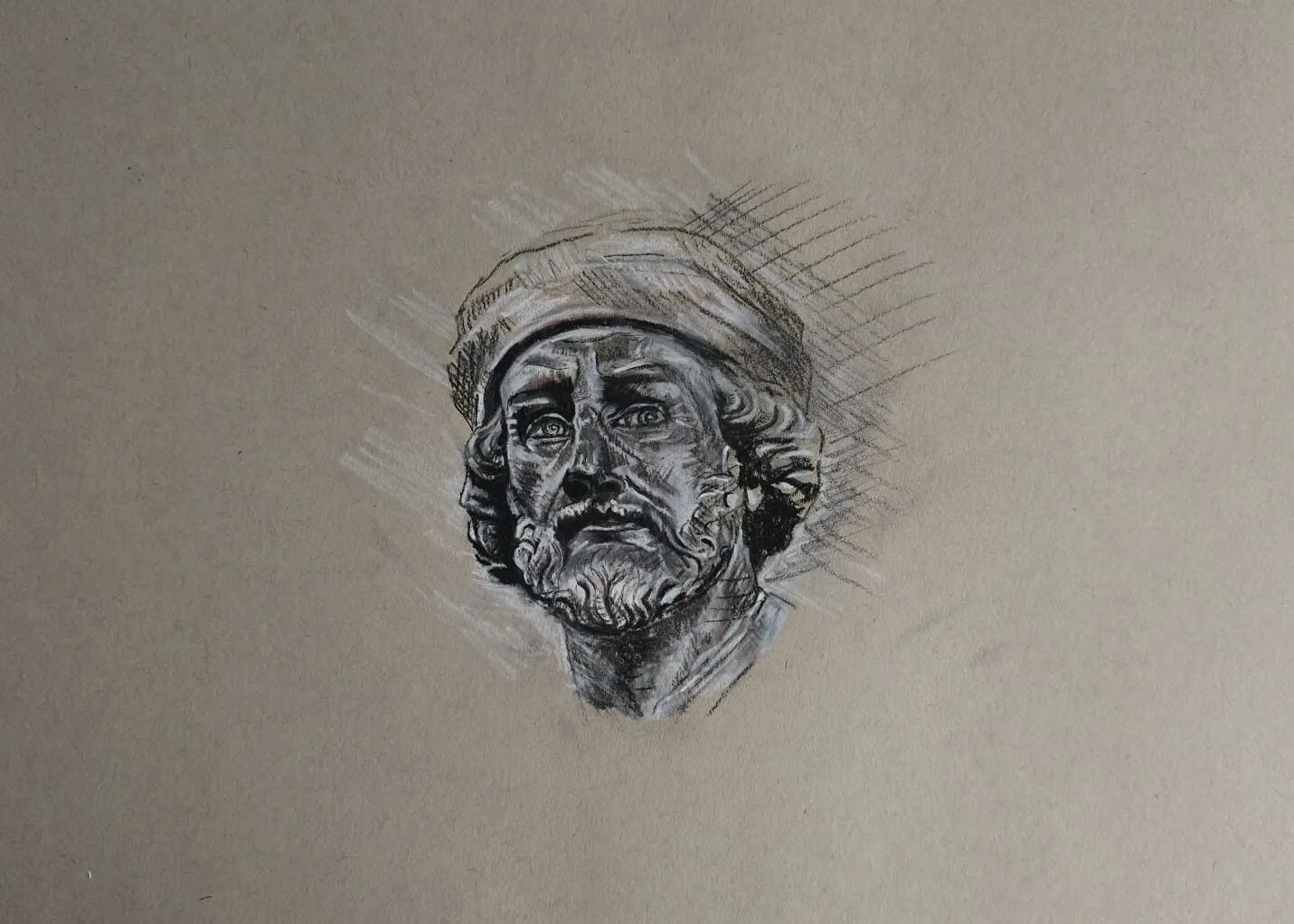
A head study of a bearded man wearing a cap in dark and white pencil on toned paper. Drawing by Michael Brace.
Quick recommendations
| If you want | Start with |
|---|---|
| A first visit as a beginner | Royal Drawing School exhibitions, the Courtauld Gallery, Musée d’Orsay |
| Realism and anatomy | British Museum, Ashmolean Museum, Uffizi |
| Expressive drawing | Musée d’Orsay, Morgan Library, Royal Drawing School |
| Old Master studies | Louvre, British Museum, Uffizi |
| Contemporary drawing | Royal Drawing School, Metropolitan Museum, Morgan Library |
How to visit a drawing collection
Drawings are light-sensitive, so many institutions rotate them, show them for short periods or keep them in storage. That means the drawings you most want may not be on the wall. Three habits make the difference.
Use the study room or print room
A study room (sometimes called a print room, or a department of prints and drawings) lets visitors request specific works to view under supervision. The general pattern is that you contact the museum in advance, sometimes register, say which works or artists interest you, and are given a time slot. Requirements differ: some rooms ask for a stated purpose, some limit the number of items, and most restrict what you can bring in. Treat what you find on the official website as authoritative, and give plenty of notice.
Prepare a shortlist before you write. Look through the online collection database, note catalogue numbers where available, and ask for a small number of works you will spend real time on rather than a long list you will skim.
Look at how the drawing was made
Once a drawing is in front of you, resist the urge to photograph it and move on. Ask yourself:
- Where is the first, lightest structural line, and how sure is it?
- Where has the artist corrected, and did they erase or leave the mistake visible?
- How does pressure change across a single stroke?
- How much of the paper is left untouched, and how does that work as light?
- What is the paper colour doing to the tones?
- Where did the artist stop, and why does it still feel finished?
These questions apply as much to a quick Degas as to a laboured Ingres, and they connect directly to how you work. Try them beside how a realistic drawing comes together to see the build-up from your side of the paper.
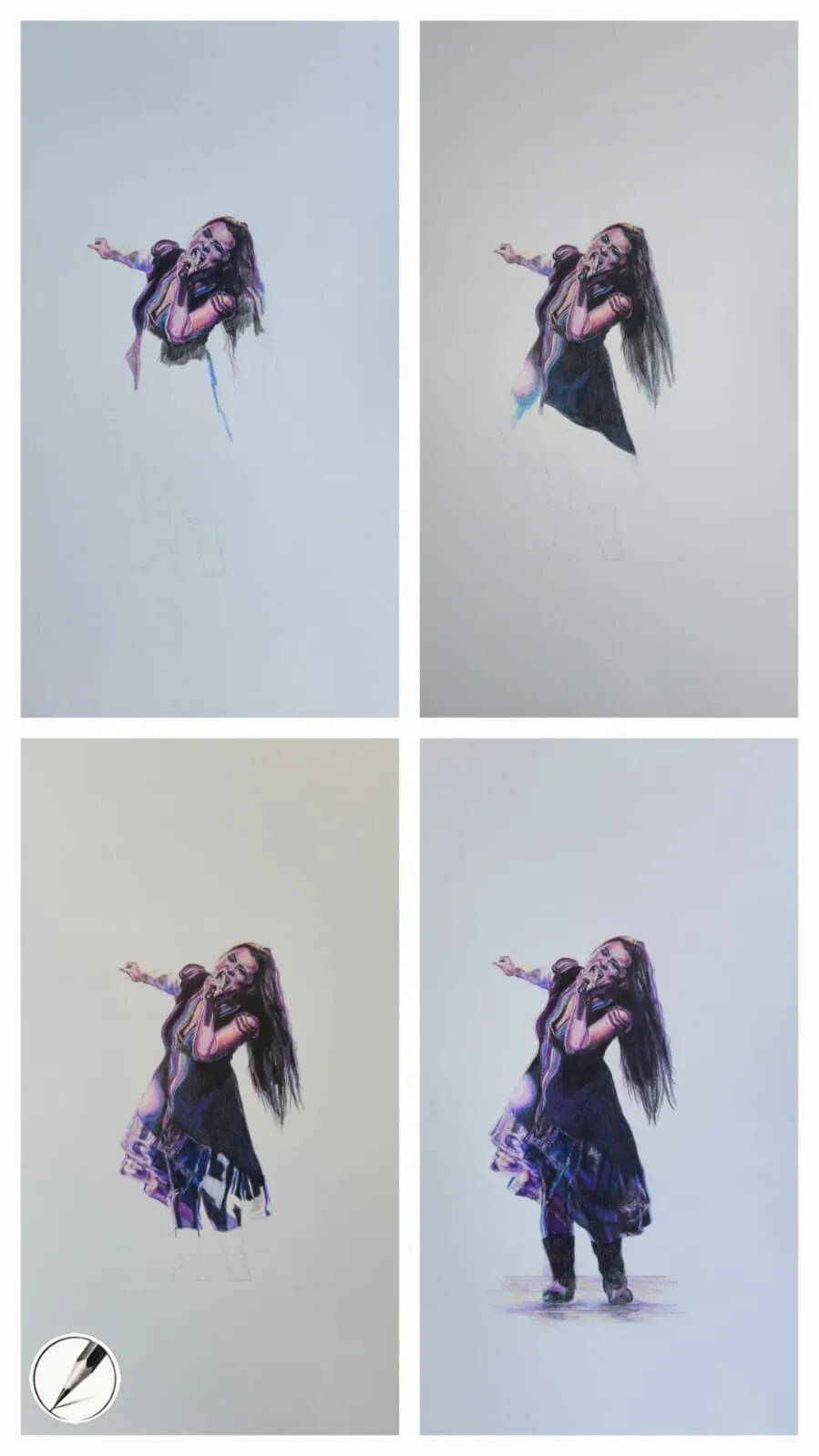
Studying stages, not just results, is the point of visiting original drawings. Michael’s own progress figures show the same idea: layout first, colour built up in layers, detail last.
Sketch, but follow the rules
Sketching in a gallery is one of the best ways to slow down and see. Most museums allow drawing with dry media in public galleries, though rules vary by institution and room. Pens, inks, easels and wet media are commonly restricted, and study rooms usually allow pencil only. Check the visitor guidance before you go, and ask staff if you are unsure.
Keep sketches short and structural: a five-minute gesture, a quick diagram of where the lights and darks fall, a note of the paper tone. A small sketchbook is enough, and our guide to the best sketchbooks for coloured pencil can help you pick one that survives carrying.
Turning a visit into better drawings
The value of a museum trip is in what you do afterwards. Write up your notes the same day while you still remember the drawing. Choose one technique you saw, such as economy of line, the way paper tone was used as a mid-value, or the way a figure was built from a single gesture, and apply it to a small study within a week.
If you want structure, our guide to master draughtsmen to study suggests artists to look for on your visit, and best drawing courses covers taught routes if you want feedback as well as inspiration. The colour ideas in old drawings on toned paper also connect to our piece on why to use grey paper for coloured pencil.
The short version
For Old Master draughtsmanship, prioritise the British Museum, the Louvre and the Uffizi. For expressive figure work, look at the Courtauld, Musée d’Orsay and the Morgan. For range, choose the Met or the National Gallery of Art. For contemporary drawing, watch the Royal Drawing School. Whatever you pick, book a study room where you can, look at how each drawing was made, and take one lesson home.
Quick answers
Frequently asked questions
Which museum has the best collection of drawings?+
There is no single answer. The British Museum, the Louvre and the Uffizi are outstanding for Old Master drawing, the Morgan Library and the Met offer huge range, and the Courtauld is strong for expressive figure work. Choose by the period and skill you want to study.
Can I see drawings that are not on display?+
Often, yes. Many museums keep drawings in a print room or study room and let visitors request works by appointment. Procedures differ, and some require advance contact or registration, so check the museum's website before you go.
Can I sketch in a museum or gallery?+
Usually, with dry media such as pencil, but rules vary by institution and room. Pens, easels and wet media are often restricted, and study rooms may only allow pencil. Check the official visitor rules before you go and ask a member of staff if unsure.
How do I get the most from looking at old master drawings?+
Look at how the drawing was built rather than only at the subject. Notice the first light lines, corrections, where pressure increases and where the artist leaves the paper untouched. A short notebook sketch of the structure teaches more than a photograph.