Coloured Pencils
The Best Coloured Pencils for Serious Artists
The best coloured (colored) pencils for serious artists: Polychromos, Luminance and Lightfast, with picks by need, what to look for and a comparison table.
This guide contains affiliate links. If you buy through them we may earn a small commission at no cost to you. How this works.
Jump to recommended products
Key takeaways
- ◆The professional standards are Faber-Castell Polychromos, Caran d'Ache Luminance and Derwent Lightfast; each excels at a different kind of drawing.
- ◆Choose Polychromos for crisp detail and value, Luminance for creamy portraits and soft realism, and Lightfast as the balanced all-rounder.
- ◆Judge any pencil on pigment load, layering, lightfastness, core strength and colour range, not on price alone.
- ◆Derwent Coloursoft is a rich, painterly wax pencil that suits artists who want softness at a friendlier price.
- ◆Paper and technique matter as much as the pencil, so budget for both.
Choosing coloured pencils, or colored pencils as US readers say, is a little like choosing an instrument: the tool shapes the performance, and the wrong one makes a skilled artist feel clumsy. The best pencils give predictable layering, strong pigment and a smooth feel on paper. They respond to pressure changes, allow subtle transitions and do not crumble in the sharpener.
Three names keep appearing in serious studios: Faber-Castell Polychromos, Caran d’Ache Luminance and Derwent Lightfast. This guide explains what sets them apart, what to look for in any professional pencil, and which one to buy for the work you actually do. It is part of our complete coloured pencil guide. Buying a whole set? See best coloured pencil sets, compare Prismacolor vs Polychromos, or take the pencil set quiz for a shortlist.
Our picks at a glance
| Need | Pick | Why |
|---|---|---|
| Crisp detail, fur, glass, metal | Faber-Castell Polychromos | Firm, oil-based, holds a sharp point, endless clean layers |
| Portraits and soft realism | Caran d’Ache Luminance | Creamy, opaque, exceptional for skin |
| One pencil for everything | Derwent Lightfast | Balanced softness, smooth layering, top-tier lightfastness |
| Rich, painterly colour on a budget | Derwent Coloursoft | Velvety, soft-blending wax pencil |
| Widest colour choice | Faber-Castell Polychromos | Widest range of the three professional favourites |
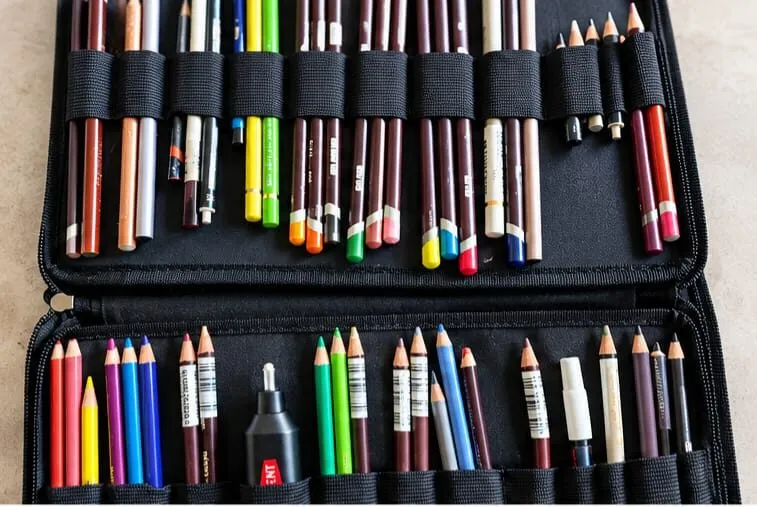
An open pencil case holding coloured pencils, pens and a small bottle.
What to look for in a serious coloured pencil
Five qualities separate professional pencils from the rest.
Pigment load. More pigment and less filler means richer colour from lighter pressure, which leaves room for more layers. Weak pencils need heavy pressure to show colour, and that flattens the paper’s tooth.
Layering. A good pencil lets you build dozens of thin layers without clogging the surface or developing a waxy haze. Firm cores tend to layer cleanly for longer; soft cores build colour faster but fill the tooth sooner.
Lightfastness. This is how well a colour resists fading. If you sell or exhibit work, it matters a great deal. Professional ranges publish ratings for their colours, and it is worth checking the specific pencils you plan to use. Read coloured pencil lightfastness explained for how the ratings work.
Core strength. The core should survive sharpening and pressure. Cores that snap waste money and interrupt work; sometimes the sharpener is the cause, so see best pencil sharpeners for coloured pencils.
Colour range. A wide range means less mixing; a curated one can be lovely if the colours suit your subject. Polychromos has the widest range of the three favourites, while Luminance is smaller but beautifully curated, with exceptional skin tones. Ranges change, so check current colour lists.
Faber-Castell Polychromos: the precision choice
Polychromos are oil-based and firm. That makes them perfect for crisp edges, fine detail and clean layering. They hold a point beautifully and do not clog the tooth quickly, so you can build many layers without wax bloom. They are especially popular with wildlife and still-life artists, and they are the most affordable of the three professional favourites. Lightfastness is excellent overall, with a few colours varying slightly.
If you love precision, Polychromos feel like home. If you want buttery soft gradients over large areas, they are less indulgent than a wax pencil. Read the full Faber-Castell Polychromos review.
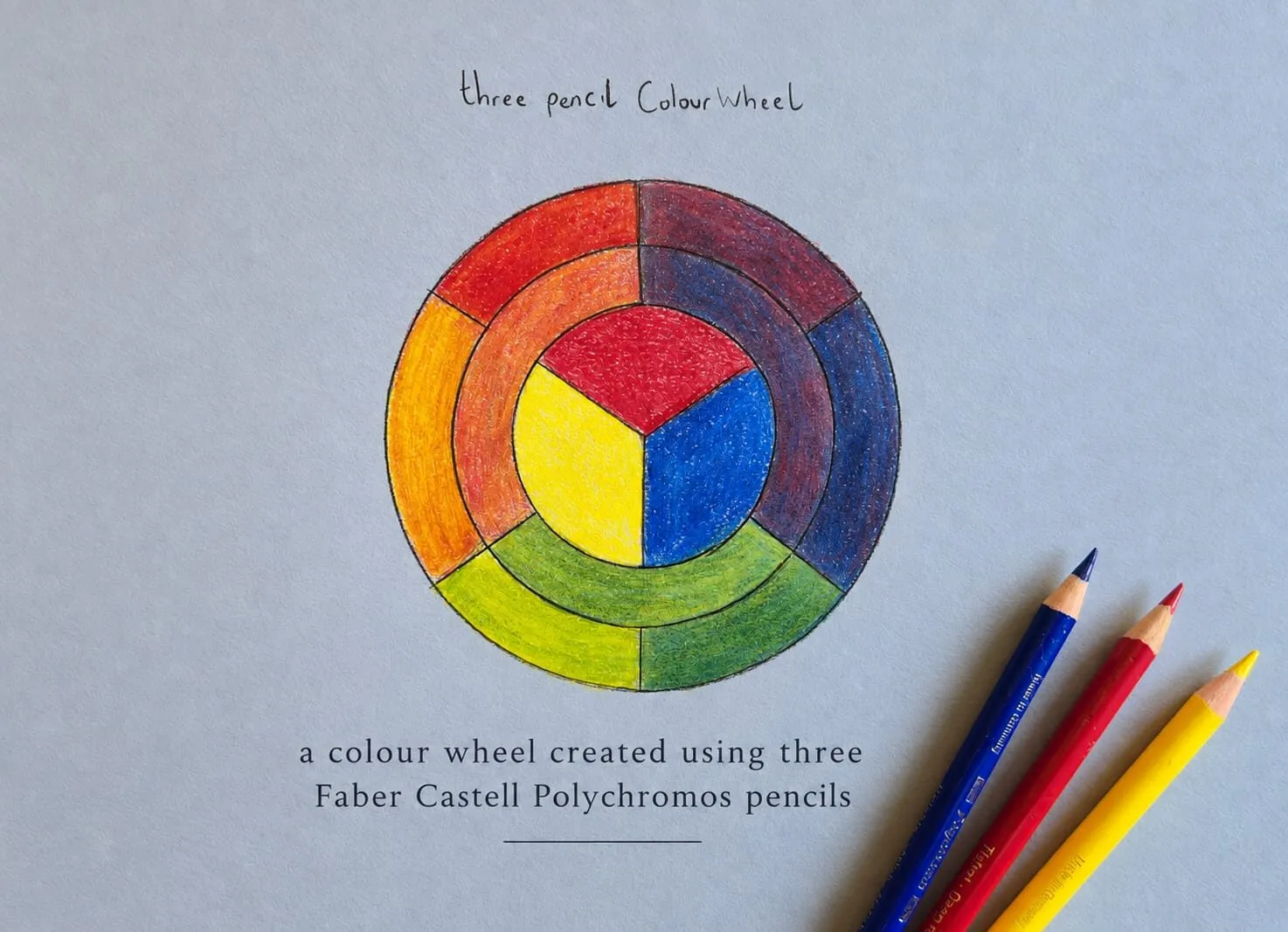
A hand-drawn colour wheel made with three Faber-Castell Polychromos pencils on blue-grey paper. Drawing by Michael Brace.
Caran d’Ache Luminance: the creamy premium choice
Luminance is wax-based, soft, creamy and opaque. It deposits rich pigment quickly, blends effortlessly and burnishes into a smooth, unified surface. It is ideal for portraits, soft realism and rich colour depth, and it is the most expensive of the three. Skin tones are a particular strength.
The trade-off is cost and a softer point, so it is not the pencil for very fine, hard-edged detail. Our Caran d’Ache Luminance review covers who gets the most from it.
Derwent Lightfast: the balanced all-rounder
Lightfast sits between the two. It is smoother than Polychromos but firmer than Luminance, with smooth layering, clean burnishing and top-tier lightfastness. Its range is growing, with strong earth tones and neutrals. It is priced mid to high: professional, but a little more accessible than Luminance.
It suits artists who want one pencil that handles both detail and softness, and it is excellent for building depth in shadows and skin.
Derwent Coloursoft: soft and painterly
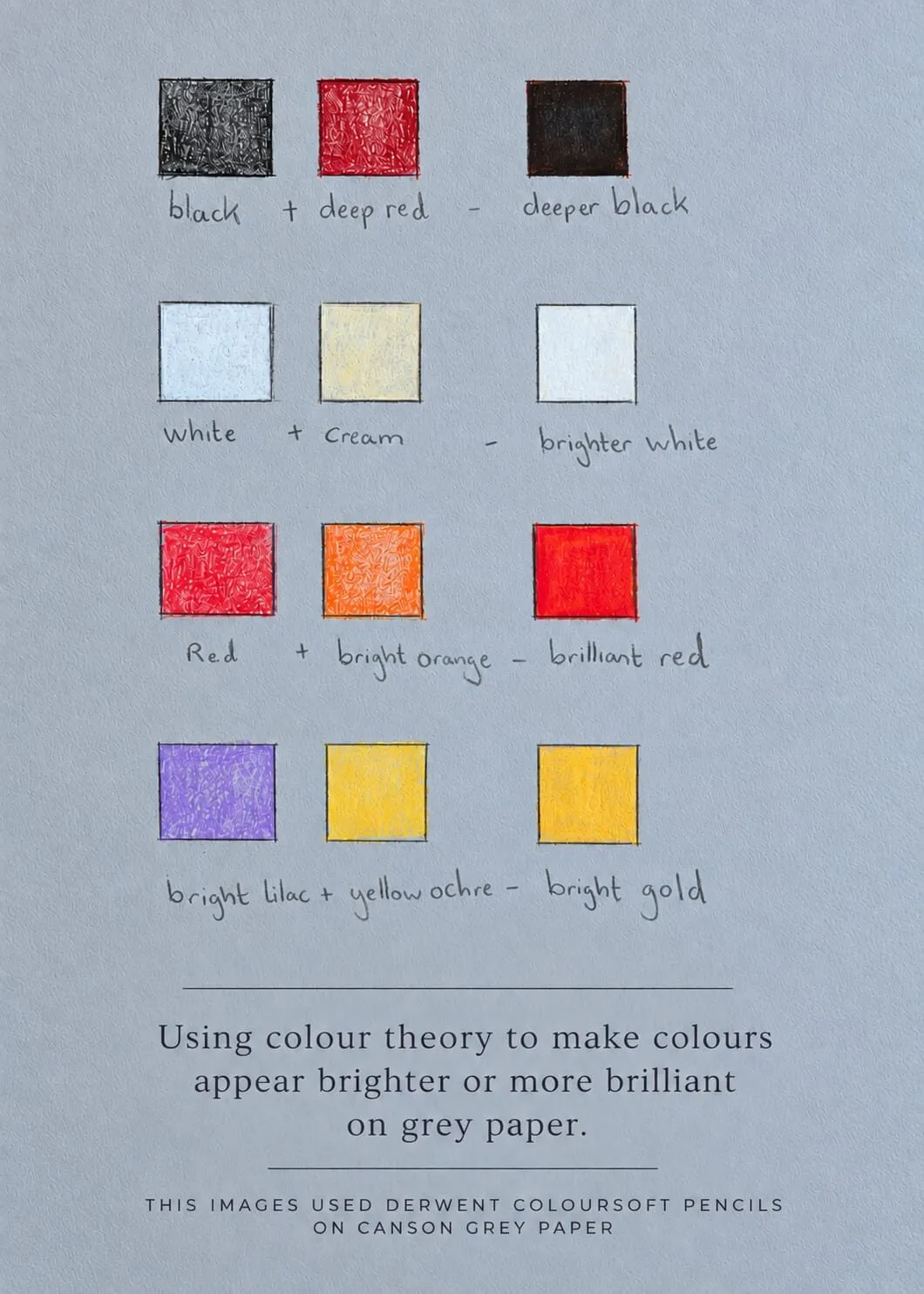
Coloursoft is velvety and rich, great for soft blending and painterly effects. It is a friendlier price point than the premium ranges and appears in Michael’s hand-drawn swatch work on grey paper. It is a good choice if you love a soft, creamy laydown and want to work expressively. For its place in the wider Derwent family, see our Derwent coloured pencils reviewed.
Which one to buy
Match the pencil to the subject.
- Portraits. Luminance and Lightfast for skin, Polychromos for detail in eyes and hair. See best coloured pencils for portraits.
- Wildlife and fur. Polychromos for fur and feathers, with a softer pencil for eyes and noses.
- Still life, glass and metal. Polychromos for crisp edges and reflections; softer wax for rich food textures and painterly finishes.
- Everything. Lightfast.
For a feature-by-feature breakdown, read Polychromos vs Luminance vs Lightfast. If you are unsure whether the jump to artist grade is worthwhile, professional versus student coloured pencils explains what you gain.
Why professional pencils behave differently
Professional pencils are not simply nicer versions of student pencils. They are defined by high pigment concentration, excellent lightfastness, smooth layering, predictable behaviour and strong cores that resist breakage. In practice that gives you five advantages:
- Cleaner layering. Colours stay clear as layers accumulate instead of turning grey.
- More subtle blending. Gradual transitions need pigment that responds to small pressure changes.
- Better colour accuracy. A pencil that looks the same across the range makes colour matching predictable.
- Greater control over pressure. The same pencil can give a whisper or a dark accent.
- Consistent results. Fewer surprises across the whole set.
If you have ever struggled with muddy colours or waxy build-up, better pencils solve most of those problems, although technique and paper account for the rest. For artists who sell work, exhibit or simply want drawings to last for decades, professional pencils stop being a luxury and become a necessity. The trade-offs, including when student pencils are still the smarter buy, are set out in professional versus student coloured pencils.
Amateur and mid-career: what changes
Amateur artists find these pencils make learning easier because they behave predictably: pressure, layering and blending do what you expect, so you spend your effort on drawing instead of fighting the tool. Mid-career artists value the nuance: subtle shifts in pressure, delicate transitions and the ability to build dozens of layers without wax bloom or muddy colour. If you are moving from hobbyist to serious practice, upgrading to one of these sets can feel like stepping into a new medium.
That said, upgrade in stages. Buy the pencils for the subject you draw most, learn them thoroughly and let your next purchase be led by what you find missing. Keep a swatch card so you know exactly what each pencil does on your paper.
Get more from any pencil
Professional pencils reward technique. Begin with light pressure and build gradually, so each layer sits on open tooth. Learn to layer coloured pencils properly, then use burnishing at the end for a polished finish. Wax bloom, the waxy haze that can appear on heavily layered wax pencils, is easier to avoid when you keep pressure light early on.
The short version
Buy Polychromos for precision and value, Luminance for portraits and luxury, and Lightfast if you want one professional pencil that does most things well. Add Coloursoft if you enjoy a soft, painterly laydown. Whichever you choose, pair it with sturdy paper and patient layering. New to the medium? Start with the beginner picks instead.
Where to buy
Recommended products
Affiliate links. We may earn a small commission if you buy, at no extra cost to you. Why?
Pencils · Faber-Castell
Faber-Castell Polychromos
Firm, oil-based artist pencils that hold a point - a benchmark for detail and clean layering.
Pencils · Derwent
Derwent Coloursoft Pencils
Soft, velvety and richly pigmented - excellent for painterly blending and bold colour.
Pencils · Derwent
Derwent Lightfast Coloured Pencils
Premium, creamy pencils with excellent lightfastness - well suited to professional realism.
Pencils · Caran d'Ache
Caran d'Ache Pencils
Premium artist pencils - Luminance is creamy and opaque for portraits, Pablo is firmer for detail.
Quick answers
Frequently asked questions
What is the best coloured pencil brand overall?+
There is no single winner. Faber-Castell Polychromos, Caran d'Ache Luminance and Derwent Lightfast are the professional favourites because each balances softness, control and reliability. Polychromos suits detail, Luminance suits portraits and rich colour, and Lightfast sits between them. Pick by the subject you draw most.
Are Polychromos better than Luminance?+
They are different rather than better. Polychromos are oil-based and firm, ideal for fine detail and clean layers. Luminance is wax-based, softer and more opaque, ideal for skin and painterly depth. Luminance is also the more expensive of the two, so budget can decide it.
How many pencils do I need in a professional set?+
Fewer than you might think. A mid-sized set covers most subjects if you layer to mix colours, then you can add open stock for colours you use constantly. Large sets are convenient but not essential, and range sizes change, so check current listings before buying.
Is Derwent Coloursoft a professional pencil?+
Coloursoft is a velvety wax pencil loved for soft blending and painterly effects, and many working artists use it. For work you plan to sell, check the lightfastness information for the specific colours you use, as we would with any pencil.
Are colored pencils and coloured pencils the same?+
Yes. Coloured pencils is the British spelling and colored pencils is the American one, and both describe the same drawing medium: pigment in a wax or oil binder, set in a wooden barrel. Brands, sets and techniques do not change with the spelling, so advice about one applies equally to the other. Only shop listings and product names follow one spelling or the other.