Books & Courses
Best Books for Botanical Drawing
Ten respected botanical drawing books, from Wendy Hollender's Botanical Drawing in Color to the Kew Book, with who each suits and picks for colored pencil.
This guide contains affiliate links. If you buy through them we may earn a small commission at no cost to you. How this works.
Jump to recommended products
Key takeaways
- ◆For coloured pencil artists, Wendy Hollender's Botanical Drawing in Color is the most directly useful title.
- ◆The Joy of Botanical Drawing is the gentlest way in, ideal for beginners or anyone returning after a break.
- ◆Botanical Art Techniques from the ASBA is the broadest, covering graphite, coloured pencil, watercolour, pen and ink.
- ◆Most of the professional titles teach watercolour, but their observation and accuracy lessons transfer to any medium.
- ◆The Laws guide adds the outdoor habit of drawing plants from life, quickly and accurately.
Botanical drawing is one of the most disciplined and rewarding forms of art. It asks for accuracy, patience, subtle shading and a real understanding of plant structure: how a leaf joins a stem, how petals overlap, where the light turns a form. The training pays off well beyond flowers. Coloured pencil and graphite artists often say that careful plant studies sharpen everything else they draw.
This list covers ten respected books, organised from gentle introductions to professional-level guides. Whether you are learning to look more closely or refining your realism, the right one can move you on quickly. For a wider view of improvement, start with how to get better at drawing, and see the general best books to improve your drawing.
If you want to try before you buy, follow a lesson on how to draw a rose or how to draw a tree. Botanical work is a natural fit for colored pencil, so the best coloured pencil sets and the beginner’s guide to coloured pencil drawing are useful companions.
The ten books at a glance
| Book | Author | Best for | Focus |
|---|---|---|---|
| Botanical Art Techniques | American Society of Botanical Artists | Structured, multi-medium learning | Graphite, colour pencil, watercolour, ink |
| Botanical Drawing in Color | Wendy Hollender | Coloured pencil artists | Colour mixing, layering |
| The Joy of Botanical Drawing | Wendy Hollender | Beginners, returners | Simple shapes, slow observation |
| Botanical Illustration Course with the Eden Project | Rosie Martin and Meriel Thurstan | Classroom-style progression | Measuring, shading, composition |
| Botanical Illustration from Life | Isik Guner | Scientific accuracy | Observation, watercolour |
| The Art of Botanical Drawing | Agathe Ravet-Hawkins | Classical training | Linework, shading |
| Botanical Illustration: The Complete Guide | Leigh Ann Gale | Professional standards | Watercolour, composition |
| The Kew Book of Botanical Illustration | Christabel King | Institutional-level training | Watercolour, accuracy |
| Botanical Sketchbooks | Helen and William Bynum | Inspiration | Historical and modern sketchbooks |
| The Laws Guide to Nature Drawing and Journaling | John Muir Laws | Field sketching | Fast observation |
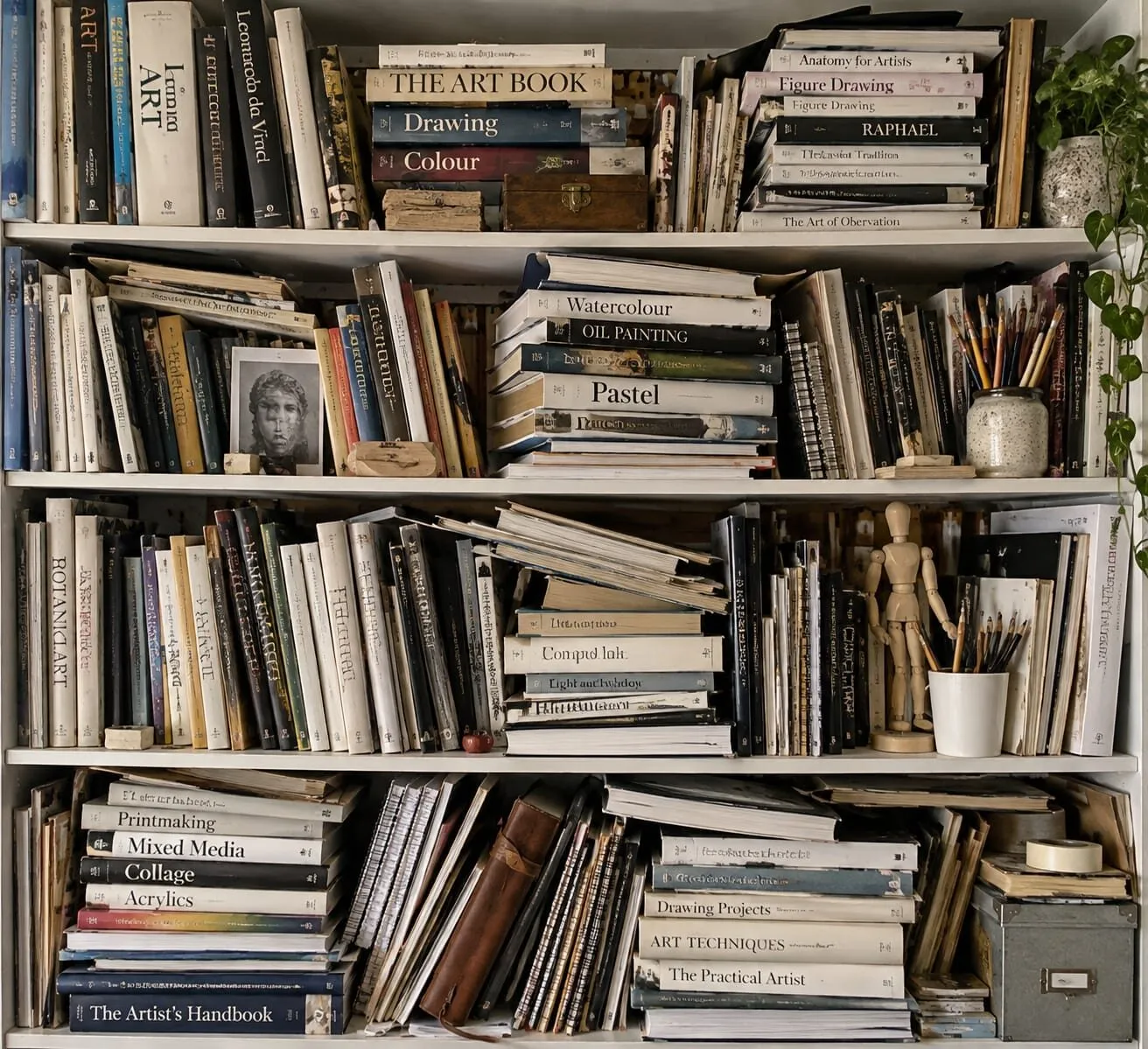
A bookshelf filled with art books and sketchbooks.
Books for getting started
1. The Joy of Botanical Drawing - Wendy Hollender
A gentle, encouraging introduction. Hollender focuses on observation, simple shapes and approachable exercises, in a friendly tone that encourages mindful, slow drawing.
Best for: beginners or artists returning to drawing after a break.
Why it matters: it makes botanical drawing feel joyful rather than intimidating, which is exactly what most people need to keep going.
2. Botanical Illustration Course with the Eden Project - Rosie Martin and Meriel Thurstan
This feels like taking a classroom course. It covers observation, measurement, shading, colour and composition, with clear progression, strong graphite and watercolour guidance and a focus on accuracy.
Best for: artists who want structured, classroom-style learning, and those building a portfolio.
Why it matters: it is one of the most structured botanical drawing books available, which suits people who work best with a syllabus.
3. The Art of Botanical Drawing - Agathe Ravet-Hawkins
A classic introduction to traditional botanical technique across graphite, ink and watercolour. It offers clear linework guidance, excellent shading techniques and a strong emphasis on structure and form.
Best for: artists who prefer classical methods.
Why it matters: it teaches the fundamentals beautifully.
Books for coloured pencil artists
4. Botanical Drawing in Color - Wendy Hollender
Hollender’s clear, friendly teaching uses coloured pencil and botanical subjects to teach form, value, colour mixing and layering. It has step-by-step projects that build confidence.
Best for: coloured pencil artists and amateurs learning colour theory.
Why it matters: it is one of the best books for learning botanical drawing in coloured pencil. Read it alongside our guide to how to layer coloured pencils.
5. Botanical Art Techniques - American Society of Botanical Artists
Essentially a full course created by dozens of professional botanical illustrators, covering graphite, coloured pencil, watercolour, pen and ink and mixed media, with step-by-step demonstrations and guidance on composition and detail.
Best for: amateurs wanting structured learning, and experienced artists wanting professional-level refinement.
Why it matters: it is one of the most complete botanical art books available today, and the best single choice if you want to sample several media.
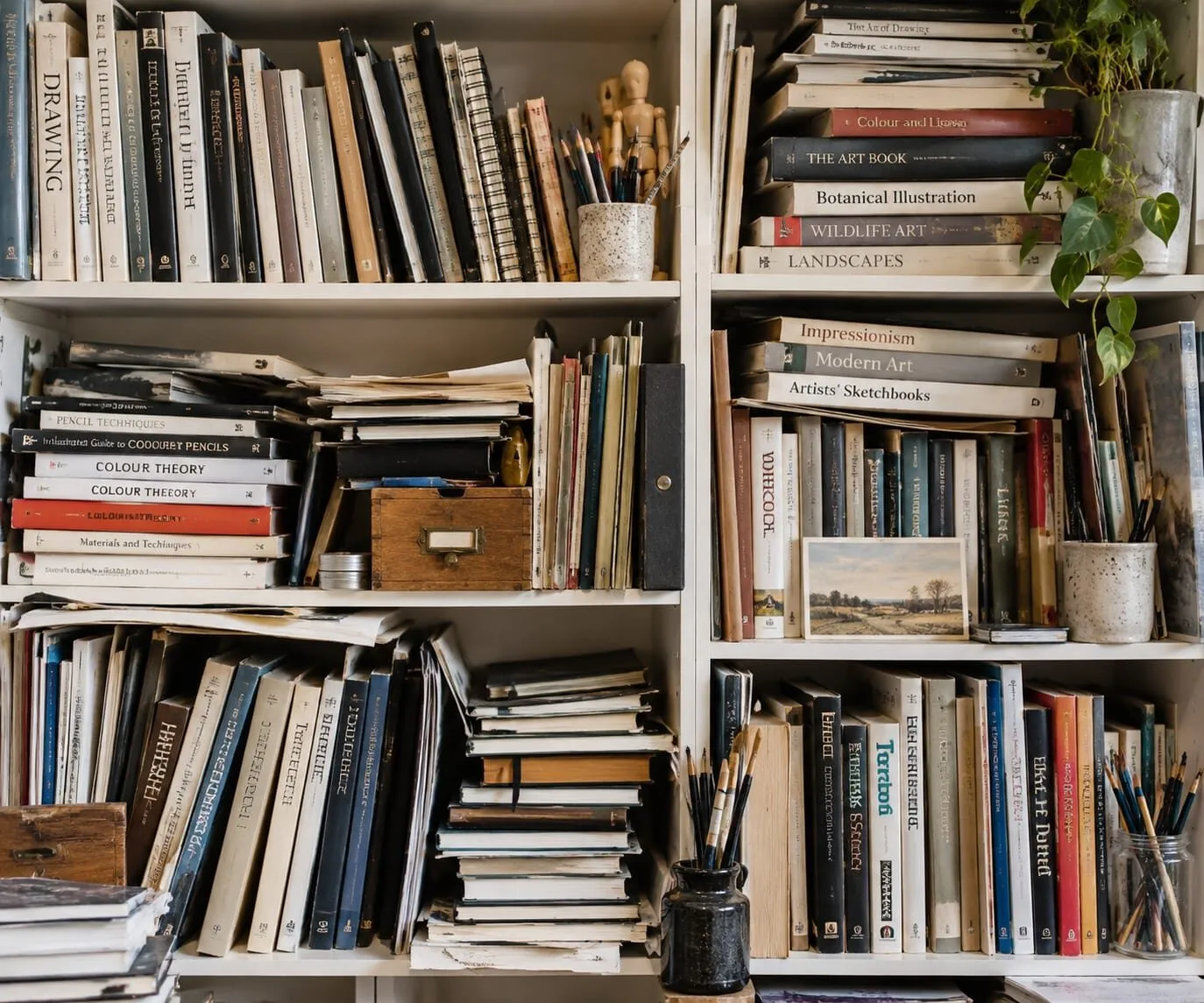
A studio bookshelf of art books, sketchbooks and brushes.
Books for professional and scientific accuracy
6. Botanical Illustration from Life - Isik Guner
Guner’s work is delicate, precise and beautifully composed. Her book teaches how to observe plants scientifically while still creating expressive art, with excellent watercolour techniques.
Best for: artists wanting professional botanical illustration.
Why it matters: it bridges the gap between science and art.
7. Botanical Illustration: The Complete Guide - Leigh Ann Gale
Aimed at artists who want work suitable for exhibitions, scientific publications or botanical societies. It has detailed watercolour techniques, a strong focus on precision and good composition guidance.
Best for: artists aiming for professional standards.
Why it matters: it is one of the best books for serious botanical illustrators.
8. The Kew Book of Botanical Illustration - Christabel King
King taught botanical illustration at Kew Gardens for decades, and her book distils that teaching into a clear, structured guide with excellent watercolour instruction and a strong focus on accuracy.
Best for: artists who want training from a leading institution.
Why it matters: it is botanical illustration at its most professional.
Books for inspiration and fieldwork
9. Botanical Sketchbooks - Helen and William Bynum
Not a step-by-step guide but a visual survey of botanical sketchbooks across centuries, with beautiful reproductions.
Best for: artists seeking inspiration and stylistic development.
Why it matters: seeing how other artists think on paper is valuable, especially for composition. It works well with our guide to master draughtsmen to study.
10. The Laws Guide to Nature Drawing and Journaling - John Muir Laws
Although not strictly botanical, this teaches how to observe plants in the field, sketch quickly and capture natural forms accurately, with excellent field-sketching technique.
Best for: artists who want to draw plants outdoors or improve observational speed.
Why it matters: it teaches you to draw plants from life, not just from photographs.
Quick recommendations
| Goal | Choose |
|---|---|
| Beginners | The Joy of Botanical Drawing, Botanical Illustration Course with the Eden Project, Botanical Drawing in Color |
| Coloured pencil | Botanical Drawing in Color, Botanical Art Techniques, Drawing Wildlife (for texture crossover) |
| Watercolour botanical | The Kew Book of Botanical Illustration, Botanical Illustration from Life, Botanical Illustration: The Complete Guide |
| Scientific accuracy | Botanical Illustration from Life, Botanical Art Techniques, the Eden Project course book |
| Inspiration and style | Botanical Sketchbooks, The Laws Guide to Nature Drawing and Journaling |
Choosing paper and materials for botanical work
Botanical work rewards smooth, fine surfaces for delicate detail and gradual tonal transitions. Hot press papers suit fine detail; see hot press versus cold press paper to choose. If you work in coloured pencil, Faber-Castell Polychromos are a popular choice for fine, controlled detail, and our coloured pencil guides compare the options.
Course and book together
Books teach; courses correct. Botanical drawing courses at well-known gardens such as Kew and the New York Botanical Garden are respected, and we cover how to choose in our guide to the best drawing courses. Check each institution’s current offerings directly.
How to work through a botanical book
Botanical books reward a slow, systematic approach. Choose a single specimen - a leaf, a seed head, a single flower - and draw it several times with different aims: once as a simple outline to fix proportion, once as a tonal study to learn how light turns around the form and, if you use colour, once as a colour study with a limited palette. Most of the titles above build exactly this progression, and repeating it on one subject teaches more than a dozen quick attempts on different ones.
Measure as you go. Botanical accuracy depends on comparing sizes, angles and spacing, so use the same habits described in our guide to how to draw what you see: compare, check with a vertical, and view the drawing in a mirror to catch drift. Good lighting from one side helps too, because a single clear light source makes form and shadow far easier to read.
The short version
Start with The Joy of Botanical Drawing, then move to Botanical Drawing in Color if you work in coloured pencil, or Botanical Art Techniques if you want breadth. Add a professional watercolour title such as the Kew book for its teaching on accuracy, and the Laws guide when you are ready to draw outside.
Where to buy
Recommended products
Affiliate links. We may earn a small commission if you buy, at no extra cost to you. Why?
Book · American Society of Botanical Artists
Botanical Art Techniques
A comprehensive, multi-medium course in botanical art.
Buy on AmazonAffiliate link · opens Amazon
Book · Wendy Hollender
Botanical Drawing in Color
Colour mixing and layering through botanical subjects.
Buy on AmazonAffiliate link · opens Amazon
Book · Wendy Hollender
The Joy of Botanical Drawing
A gentle, encouraging introduction to botanical art.
Buy on AmazonAffiliate link · opens Amazon
Book · Rosie Martin & Meriel Thurstan
Botanical Illustration Course with the Eden Project
A structured, classroom-style progression of skills.
Buy on AmazonAffiliate link · opens Amazon
Book · Isik Guner
Botanical Illustration from Life
Scientific observation with expressive, delicate results.
Buy on AmazonAffiliate link · opens Amazon
Book · Agathe Ravet-Hawkins
The Art of Botanical Drawing
Classical linework, shading and structure.
Buy on AmazonAffiliate link · opens Amazon
Book · Leigh Ann Gale
Botanical Illustration: The Complete Guide
Techniques aimed at exhibition-standard botanical work.
Buy on AmazonAffiliate link · opens Amazon
Book · Christabel King
The Kew Book of Botanical Illustration
Decades of Kew teaching distilled into a clear guide.
Buy on AmazonAffiliate link · opens Amazon
Book · Helen & William Bynum
Botanical Sketchbooks
A visual feast of historical and contemporary botanical sketchbooks.
Buy on AmazonAffiliate link · opens Amazon
Book · John Muir Laws
The Laws Guide to Nature Drawing and Journaling
Field sketching, observation and naturalist journaling.
Buy on AmazonAffiliate link · opens Amazon
Quick answers
Frequently asked questions
What is the best book for botanical drawing with coloured pencil?+
Wendy Hollender's Botanical Drawing in Color uses coloured pencil and botanical subjects to teach form, value, colour mixing and layering, and it is the strongest match. The ASBA's Botanical Art Techniques also covers coloured pencil among several media and adds professional-level guidance on composition and detail.
Is botanical drawing good practice for other subjects?+
Yes. It trains patient observation, fine detail, subtle shading and delicate tonal transitions, all of which transfer to portraits, still life and realism. Many coloured pencil artists find that a few months of careful plant studies improves their control of value and edges everywhere else.
Do I need watercolour for botanical illustration?+
No. Many books focus on watercolour because it is the traditional botanical medium, but graphite and coloured pencil are widely used. Watercolour-focused books are still worth reading for their teaching on observation, accuracy and composition, which apply in any medium.
Which book is best for beginners in botanical art?+
The Joy of Botanical Drawing by Wendy Hollender is friendly, simple and encourages slow, mindful drawing. Botanical Illustration Course with the Eden Project is a good next step if you want a classroom-style progression, and Botanical Drawing in Color helps if you want to work in colour.