Books & Courses
Best Books for Animal Drawing
Ten respected animal drawing books, from Goldfinger's anatomy to Amberlyn's wildlife realism, with quick picks for beginners, birds, gesture and colored pencil.
This guide contains affiliate links. If you buy through them we may earn a small commission at no cost to you. How this works.
Jump to recommended products
Key takeaways
- ◆Realistic animals start with anatomy: Goldfinger is the deep reference, Ellenberger's atlas the simpler one.
- ◆For gesture and life, Hultgren and Knight teach movement, posture and dynamic poses.
- ◆Beginners are best served by Jack Hamm and Hugh Laidman, who simplify animals into buildable shapes.
- ◆Amberlyn's books are the most useful for fur, feather and eye rendering, especially in coloured pencil.
- ◆For birds, pair Sheppard's structure with Laws' field-sketching approach.
Animals are one of the most rewarding subjects to draw and one of the hardest. Each species brings its own structure, its own textures and a habit of moving the moment you start. Fur, feathers, anatomy, gesture and expression all need attention, and photographs alone rarely teach you what lies beneath the surface.
The right books shorten the learning curve. This list covers ten respected titles, grouped by what they teach best: anatomy, gesture and form, realism and birds. It suits both newer artists and those refining realism. For the general path to improvement, start with how to get better at drawing, and for the general list see the best books to improve your drawing.
To put a book into practice, try a lesson on how to draw a dog, how to draw a horse or how to draw a bird. Fur and feather work suits colored pencil well, and the best coloured pencil sets guide can help you choose one.
The ten books at a glance
| Book | Author | Best for | Focus |
|---|---|---|---|
| Animal Anatomy for Artists | Eliot Goldfinger | Anatomical accuracy | Skeleton, muscle, movement |
| An Atlas of Animal Anatomy for Artists | Ellenberger, Dittrich and Baum | Clear reference | Horses, dogs, cattle |
| The Art of Animal Drawing | Ken Hultgren | Gesture and life | Movement, posture, personality |
| Drawing Animals | Hugh Laidman | Structure and form | Building with basic shapes |
| How to Draw Animals | Jack Hamm | Beginners | Many species, simple demos |
| Drawing Wildlife | J.C. Amberlyn | Wildlife realism | Fur, feathers, eyes |
| The Big Book of Realistic Animal Drawings | J.C. Amberlyn | Broad realism reference | Pets, domestic and complex species |
| Drawing Birds | Raymond Sheppard | Bird drawing | Feathers, wings, structure |
| The Laws Guide to Drawing Birds | John Muir Laws | Field accuracy | Observation, sketching |
| Animal Drawing: Anatomy and Action for Artists | Charles R. Knight | Dynamic realism | Action poses, anatomy |
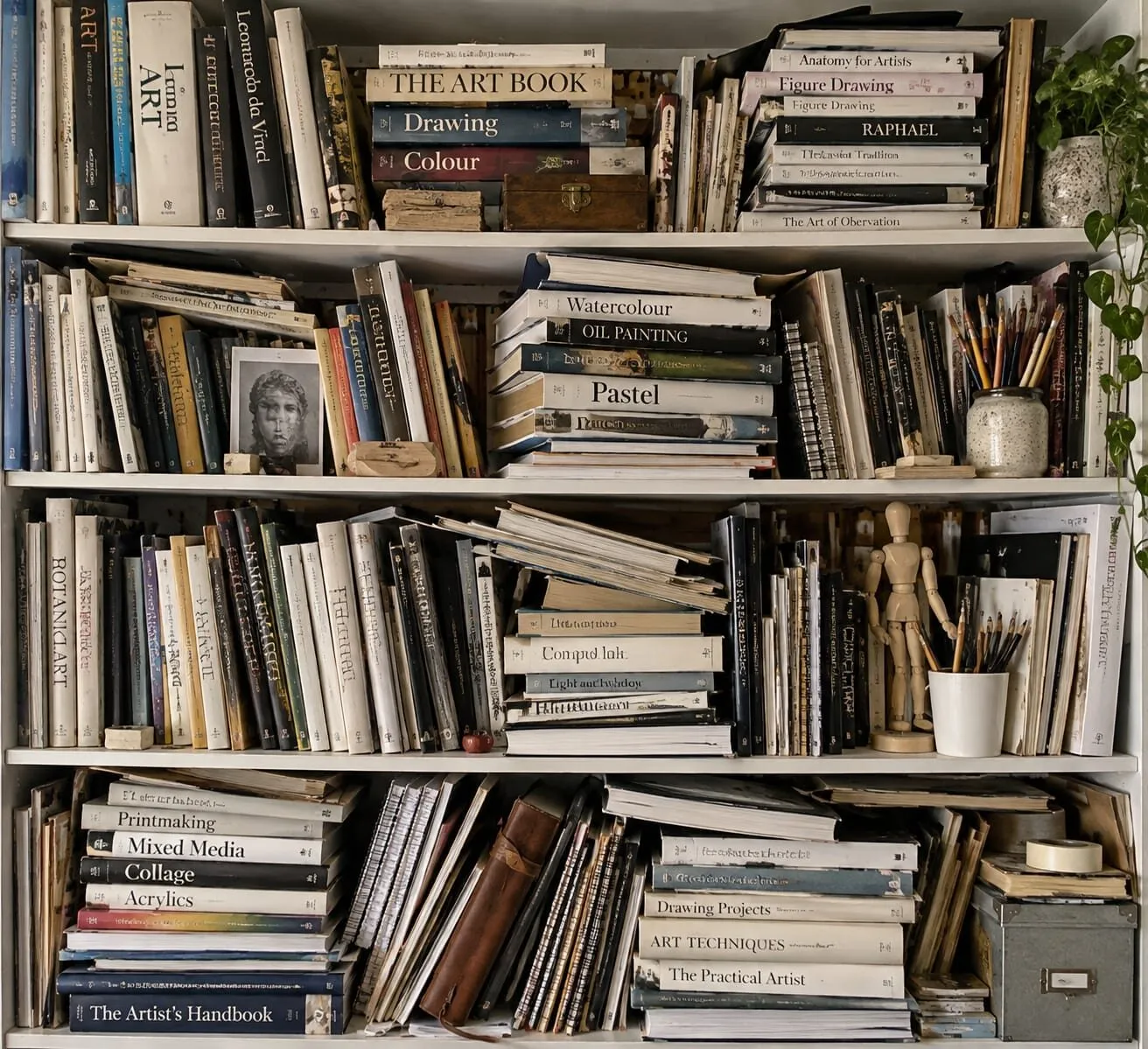
A bookshelf filled with art books and sketchbooks.
Anatomy: the blueprint
1. Animal Anatomy for Artists - Eliot Goldfinger
The definitive anatomy reference for serious animal artists. It covers skeletal structure, muscle groups, movement and proportion across dozens of species, with detailed diagrams and clear comparisons between species.
Best for: artists seeking anatomical accuracy, and amateurs ready to deepen their understanding of structure.
Why it matters: realism begins with anatomy, and this book gives you the blueprint. It explains why animals move the way they do, which helps in both drawing and sculpture.
2. An Atlas of Animal Anatomy for Artists - Ellenberger, Dittrich and Baum
An older classic that is still widely used, with clean, precise anatomical drawings of horses, dogs and cattle that make structure easy to understand.
Best for: artists who want simple, clear anatomical reference.
Why it matters: it is among the most accessible anatomy references available, and a good companion to Goldfinger’s more detailed text. Use the atlas first if Goldfinger feels dense.
Gesture, form and approachable starts
3. The Art of Animal Drawing - Ken Hultgren
Hultgren shows how to capture the essence of animals: their movement, posture and personality. His approach blends realism with animation-style gesture.
Best for: amateurs learning gesture, and experienced artists wanting more expressive drawings.
Why it matters: gesture is the soul of animal drawing. The book teaches dynamic poses and helps you loosen up so that animals look alive rather than stuffed.
4. Drawing Animals - Hugh Laidman
Laidman simplifies animals into basic shapes and teaches you to build form before adding detail. It suits artists who struggle with proportion or volume.
Best for: improving structure and form; excellent for beginners and useful for refining construction.
Why it matters: if the form is built correctly, detail becomes far easier. It is the book to reach for when your animals look flat or lopsided.
5. How to Draw Animals - Jack Hamm
Hamm’s books are famously accessible. This one covers dogs, cats, horses, birds and wildlife with simple, clear demonstrations, and it is good for quick studies.
Best for: amateurs who want approachable guidance across many animals.
Why it matters: it is one of the best beginner-friendly animal drawing books, ideal when you want a broad first look rather than depth.

A studio bookshelf of art books, sketchbooks and brushes.
Realism: fur, feather and eye
6. Drawing Wildlife - J.C. Amberlyn
Amberlyn concentrates on wildlife realism in coloured pencil and graphite: fur, feathers, eyes and natural textures. The demonstrations are detailed yet approachable, with clear step-by-step guidance.
Best for: artists who want realistic wildlife drawings, particularly coloured pencil artists.
Why it matters: wildlife realism needs texture mastery, and Amberlyn teaches it clearly. Pair it with our guide to drawing animal fur.
7. The Big Book of Realistic Animal Drawings - J.C. Amberlyn
This expands on Amberlyn’s wildlife techniques to cover domestic animals, pets and more complex species, with strong shading guidance and a focus on eyes, fur and expression. We do not attach a product card to this title, so check current editions with your bookseller.
Best for: amateurs and experienced artists wanting a broad reference.
Why it matters: it is one of the most complete realism guides available, and useful if you draw commissions of pets.
Birds
8. Drawing Birds - Raymond Sheppard
Birds are notoriously difficult because feathers, wings and proportions demand precision. Sheppard’s book is one of the best resources for understanding avian structure, with clear feather rendering techniques and excellent wing anatomy.
Best for: artists who want to improve bird drawing.
Why it matters: birds need a distinct skill set, and this teaches it well for both realism and expressive work.
9. The Laws Guide to Drawing Birds - John Muir Laws
Laws blends natural science with art, teaching how to draw birds accurately in the field and in the studio. It is strong on quick observation and clear anatomical breakdowns.
Best for: artists who want accuracy and naturalism.
Why it matters: it suits artists who want to work directly from living birds rather than only from photographs.
Dynamic realism
10. Animal Drawing: Anatomy and Action for Artists - Charles R. Knight
Knight was one of the most influential wildlife artists of the twentieth century. His book concentrates on movement, anatomy and expressive poses, with lessons in action.
Best for: experienced artists wanting dynamic realism.
Why it matters: Knight blends realism with energy, ideal for artists who want more dynamic compositions, whether wildlife or fantasy.
Quick recommendations
| Goal | Choose |
|---|---|
| Beginners | How to Draw Animals (Hamm), Drawing Animals (Laidman), The Art of Animal Drawing (Hultgren) |
| Realism | Animal Anatomy for Artists, Drawing Wildlife, The Big Book of Realistic Animal Drawings |
| Birds | Drawing Birds (Sheppard), The Laws Guide to Drawing Birds |
| Anatomy | An Atlas of Animal Anatomy for Artists, Animal Anatomy for Artists |
| Dynamic poses | The Art of Animal Drawing, Animal Drawing: Anatomy and Action for Artists |
How to study animal books effectively
- Draw the diagrams, do not just read them. Redrawing a skeleton fixes it in memory far better than looking.
- Start with gesture. Fast, flowing lines capture life before you commit to details.
- Work from real animals where you can. Pets, zoos and birds at a feeder are all useful. Photographs help with detail but flatten movement.
- Build texture last. Fur and feathers sit on structure; if the structure is wrong, texture will not rescue it.
Once the anatomy is solid, the next step is technique in your chosen medium. See how to blend coloured pencils and the wider best books for coloured pencil artists. To make the most of your study time, follow a routine such as the one in how to practise drawing daily.
The short version
Start with Hamm or Laidman for confidence, add Hultgren for gesture, then choose Amberlyn for fur and feather realism and Goldfinger when you want anatomical depth. Sheppard and Laws cover birds, and Knight adds energy for artists ready to draw action.
Where to buy
Recommended products
Affiliate links. We may earn a small commission if you buy, at no extra cost to you. Why?
Book · Eliot Goldfinger
Animal Anatomy for Artists
The definitive animal anatomy reference for artists.
Buy on AmazonAffiliate link · opens Amazon
Book · Ellenberger, Dittrich & Baum
An Atlas of Animal Anatomy for Artists
Clear, classic anatomical diagrams of horses, dogs and cattle.
Buy on AmazonAffiliate link · opens Amazon
Book · Ken Hultgren
The Art of Animal Drawing
Gesture, movement and personality in animal drawing.
Buy on AmazonAffiliate link · opens Amazon
Book · Hugh Laidman
Drawing Animals
Building animals from simple forms before adding detail.
Buy on AmazonAffiliate link · opens Amazon
Book · Jack Hamm
How to Draw Animals
Friendly, accessible demonstrations across dozens of species.
Buy on AmazonAffiliate link · opens Amazon
Book · J.C. Amberlyn
Drawing Wildlife
Realistic fur, feathers and eyes in coloured pencil and graphite.
Buy on AmazonAffiliate link · opens Amazon
Book · Raymond Sheppard
Drawing Birds
Feathers, wings and avian structure.
Buy on AmazonAffiliate link · opens Amazon
Book · John Muir Laws
The Laws Guide to Drawing Birds
Field-sketching accuracy meets artistic clarity.
Buy on AmazonAffiliate link · opens Amazon
Book · Charles R. Knight
Animal Drawing: Anatomy and Action for Artists
Dynamic poses and anatomy from a master wildlife artist.
Buy on AmazonAffiliate link · opens Amazon
Quick answers
Frequently asked questions
What is the best book for learning to draw animals?+
For beginners, How to Draw Animals by Jack Hamm and Drawing Animals by Hugh Laidman are approachable starting points. For realism in fur, feathers and eyes, J.C. Amberlyn's books are excellent, and for anatomical accuracy, Eliot Goldfinger's Animal Anatomy for Artists is the standard reference.
Do I need to study animal anatomy to draw animals well?+
It helps a great deal for realism, especially with movement and pose, but you do not need it to start. Begin with simple shapes and gesture, then add anatomy as questions arise: why does a leg bend that way, where does the shoulder sit? A reference book answers those.
Which book is best for drawing birds?+
Raymond Sheppard's Drawing Birds is strong on feathers, wings and structure, while John Muir Laws' guide teaches accurate observation and field sketching. Together they cover the studio and the outdoors. Both suit artists who want realism as well as an understanding of how birds are built.
Are these books good for coloured pencil artists?+
Yes, particularly Drawing Wildlife by J.C. Amberlyn, which uses coloured pencil and graphite and concentrates on fur, feathers, eyes and textures. The anatomy and gesture books work in any medium, since they teach structure and movement rather than technique in one material.