
Colour Theory
Limited Palette Drawing With Coloured Pencils
Draw with three to six coloured pencils (colored pencils in the US). Benefits, example palettes described by colour, how to mix greys, and an exercise.
This guide contains affiliate links. If you buy through them we may earn a small commission at no cost to you. How this works.
Jump to recommended products
Key takeaways
- ◆A limited palette means working with three to six pencils, and it forces you to learn mixing instead of choosing from a huge set.
- ◆Restricting colours gives you natural harmony, faster decisions and a stronger grasp of value.
- ◆Good limited palettes have a warm and a cool, a dark, a light and something to mute with.
- ◆You can mix convincing greys and neutrals from your primaries and their complements.
- ◆Start with a small study, and only add a pencil when you can say exactly what it is missing.
A tin of seventy-two pencils is a pleasure to own, and a difficult thing to draw with. Every choice is available, so every choice is a decision, and the result is often a busy, uncoordinated palette. Working with only three to six pencils removes most of those decisions and teaches you more about colour than any chart.
This guide explains why limited palettes work, how to choose one, describes several example palettes by colour role, shows how to mix greys from them, and gives you an exercise. It builds on primary, secondary and tertiary colours and belongs to the colour theory cluster. This is written for coloured pencils, known as colored pencils in the US. See how many coloured pencils you need, try the palette from photo tool and browse the best coloured pencil sets.
Why work with fewer pencils
The benefits are practical.
- Automatic harmony. When every colour in the drawing comes from the same handful of pencils, the drawing holds together. The palette is the scheme.
- Better mixing. With no ready-made colour to grab, you learn what your pencils do together. That skill transfers to every set you own.
- Faster decisions. Less time choosing means more time drawing.
- Stronger values. With hue restricted, value has to do the work, which is where drawings gain their structure. See value in drawing.
- Cheaper and lighter. A few good pencils travel well and cost little.
The trade-off is that some colours are out of reach. A small set will not mix a bright, clean green if none of its pencils lean toward green. That is why choosing the set matters.
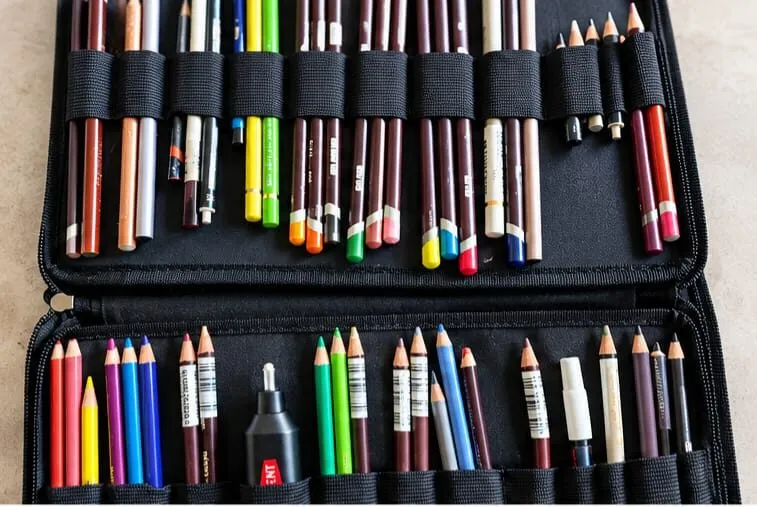
An open pencil case holding coloured pencils, pens and a small bottle.
What a good limited palette contains
Whatever the subject, most successful small palettes cover the same roles:
| Role | Purpose |
|---|---|
| A warm colour | Lit areas, skin, sunlight |
| A cool colour | Shadows, distance, contrast |
| A dark | The deepest values, and a base for neutrals |
| A light or white | Highlights and tints |
| A mid or earth colour | The bridge between them, and a neutraliser |
| An accent (optional) | One saturated note for the focal point |
Three pencils can only cover three of these, so choose the ones the subject needs most. Six can cover them all.
Example palettes, described by colour
These are described in colour terms, not by brand, so you can build them from any range. The exact pencils will differ, so swatch first and adjust.
Three-pencil palette: the primary set
A warm red, a yellow, and a blue, one of each, as in Michael’s hand-drawn wheel made with three Faber-Castell Polychromos pencils. It mixes oranges, greens and violets, and with layering, a range of neutrals. It cannot make white, so you rely on the paper, which works best on white or toned paper. Its main limit is that pencil primaries are impure, as explained in the mixing guide.
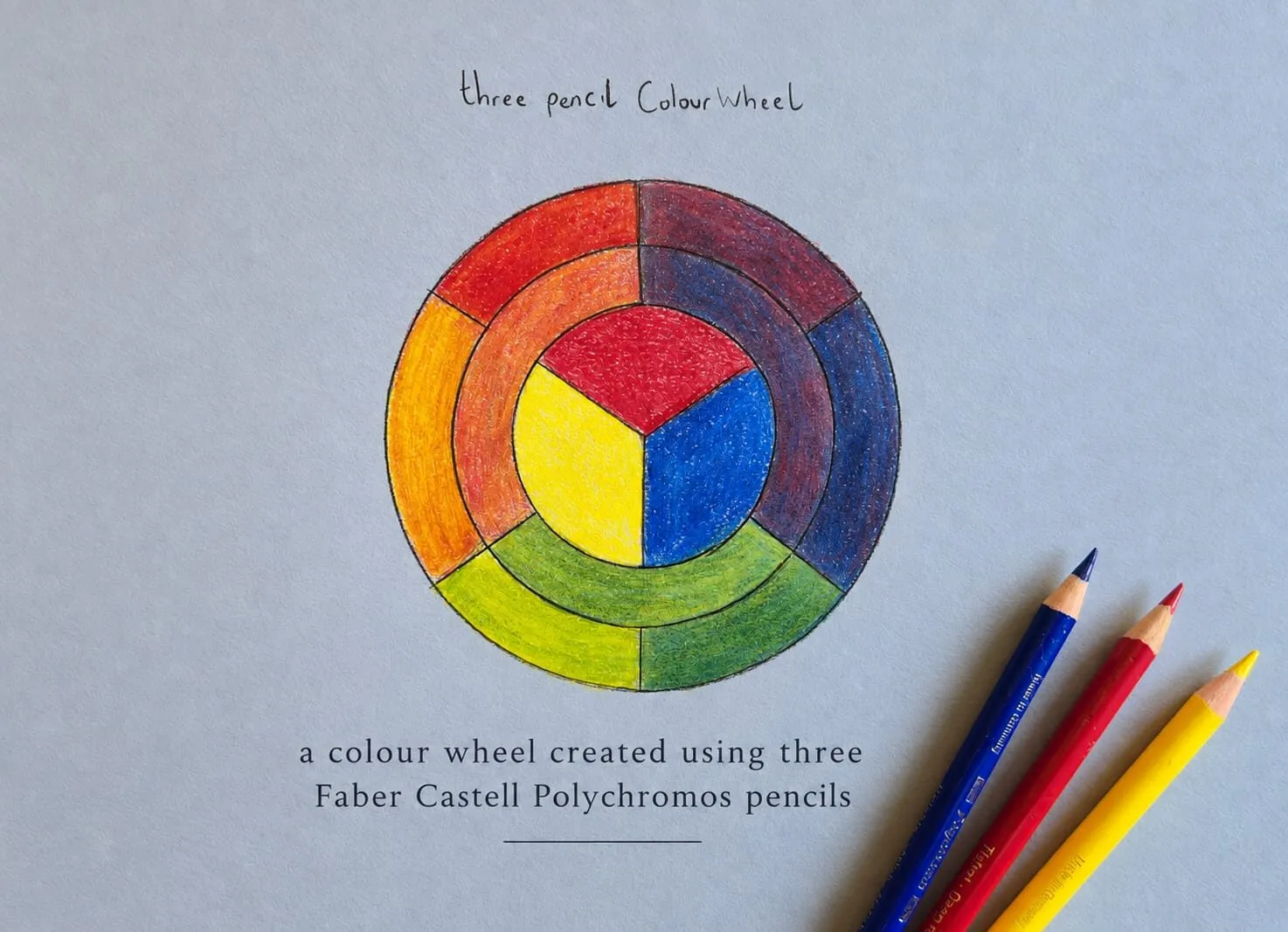
Three pencils, a whole wheel. This is the basic limited palette exercise.
Four-pencil palette: warm and cool plus a dark
A warm earth colour (a burnt orange or ochre), a cool blue, a deep brown or indigo, and white. Excellent for landscapes, animals and old-master style studies on toned paper.
Five-pencil palette: the portrait set
A yellow ochre, a rose or muted red, a mid brown, a cool grey or blue, and a white or cream. This follows the ochre, rose, grey and brown layers described in how to mix skin tones with coloured pencils.
Six-pencil palette: the still-life set
A warm and a cool red, a warm and a cool blue, a yellow and a dark. Add white from the paper, or swap the dark for white if you are on toned paper. It mixes almost any colour in a fruit-and-glass still life.
Analogous accent palette
Three neighbouring hues, such as yellow, orange and red-orange, plus a small amount of a complement as an accent. This is the palette behind a lot of warm, appetising subjects and it echoes the analogous scheme in colour harmony schemes.
Mixing greys and neutrals from a limited palette
A big advantage of a limited palette is that the neutrals come from the same pencils, so they always harmonise.
- Pick a colour and its complement. Orange and blue, red and green, or yellow and violet.
- Layer them lightly, alternating with a sharp point, until you reach a neutral.
- Lean the balance. More blue gives a cool grey. More orange gives a warm brown-grey.
- Tint with white or a pale layer for lighter neutrals.
- Deepen with a dark for shadow neutrals.
These mixed neutrals are more alive than a single grey pencil because they contain traces of colour. They are the same colours behind natural, muted shadows, as covered in complementary colours in drawing and saturation and muted colours.
Limited palettes and paper
Toned paper is effectively an extra colour in a limited palette, and a free one. On a mid grey, you may need only a dark, a light and one or two colours. See colour theory on grey paper for how pairings behave on grey, and why use grey paper for coloured pencil for the paper itself.
Exercise: a small study in five pencils
Give this an hour.
- Choose a simple subject, such as a piece of fruit, a mug or a single flower.
- Squint and make a thumbnail in three values. The value study tool can do this for a photo.
- Choose five pencils: a warm, a cool, a dark, a light and a mid or earth colour.
- Swatch them on your paper and make a small mixing grid of how they combine.
- Draw the study, building value first, then colour, using only those pencils.
- Reflect. Which colour did you miss? Which mix surprised you?
- Repeat with a different set of five and compare the moods.
If you want to plan a palette on screen first, try the colour scheme generator and reduce its suggestions to your available pencils.
Common mistakes
- Choosing five similar pencils. A palette needs a range: warm and cool, light and dark.
- Forgetting a dark. Without one, drawings look pale and washed out.
- Adding pencils too quickly. Each added pencil dilutes the discipline. Add one only when you can name what is missing.
- Ignoring undertones. Two reds that lean different ways behave differently. Swatch them.
- Expecting every colour. A limited palette gives harmony, not full colour range. Accept the limits.
When to break the limit
A limited palette is a discipline, not a dogma. Working with few pencils is most valuable when you are learning or when you want a very harmonious result, and there are good reasons to loosen it.
- A subject needs a colour you cannot mix. A bright clean green or a vivid violet may be beyond a small set. Add that one pencil.
- A commission demands accurate colour. Matching a specific object or a client’s colour may need a broader range.
- You want a surprise accent. One extra vivid pencil used sparingly can turn a quiet palette into a striking one.
The trick is to add deliberately. Write down what the new pencil does that your existing set cannot, and use it only for that job. Many working artists keep a core set they trust for most drawings and add two or three specials per piece. Over time you learn which limited palettes you love, and the habit of asking “what is the fewest I need?” stays with you even when you own hundreds of pencils.
The short version
A limited palette of three to six pencils gives natural harmony, sharper mixing skills and faster decisions. Cover the roles: warm, cool, dark, light and a bridging earth colour. Mix greys from complements, swatch on your own paper, and add a pencil only when you know exactly what is missing. Return to the colour theory hub for the next topic.
Where to buy
Recommended products
Affiliate links. We may earn a small commission if you buy, at no extra cost to you. Why?
Pencils · Faber-Castell
Faber-Castell Polychromos
Firm, oil-based artist pencils that hold a point - a benchmark for detail and clean layering.
Pencils · Derwent
Derwent Coloursoft Pencils
Soft, velvety and richly pigmented - excellent for painterly blending and bold colour.
Quick answers
Frequently asked questions
What is a limited palette in drawing?+
It is a deliberately small set of colours used for a whole drawing, often three to six pencils. Everything else is mixed by layering. Restriction creates natural harmony, because every colour in the drawing is made from the same few ingredients.
How many coloured pencils do I need for a limited palette?+
Three is the minimum for a full mixing exercise, and five or six is comfortable for most subjects. A common structure is a warm and cool version of one or two primaries, a dark and a white or light tone. Add pencils only when a specific colour cannot be mixed.
Can I draw a portrait with a limited palette?+
Yes, and it is a good way to learn skin tones. A few earth and warm colours plus a cool, a dark and a light can cover a wide range. See the skin tone guide for palettes described by colour family.
How do I mix grey from a limited palette?+
Layer a colour with its complement, such as orange with blue or red with green, and adjust the proportions. The mix shifts between warm and cool greys. Add a little white or lighter tint for paler greys. This gives more lively neutrals than a ready-made grey.
Are colored pencils and coloured pencils the same?+
Yes. Coloured pencils is the UK spelling and colored pencils is the US spelling, and they are the same product. The limited palette approach works for both.