Coloured Pencils
How Many Coloured Pencils Do You Need?
How many coloured (colored) pencils you really need, from 12 to 120. Build a core palette, learn to mix instead of own, and upgrade sensibly.
Key takeaways
- ◆Most artists draw well with a core of roughly 24 to 36 pencils, because layering lets you mix colours you do not own.
- ◆Set sizes such as 12, 24, 36, 72 and 120 are convenient categories, not levels of skill: bigger only saves time, it does not make drawings better.
- ◆Build a core palette from a warm and a cool version of each primary, a few earth tones, a dark, a light and a good white.
- ◆Buy a small set first, then fill gaps with open stock once your own drawings show which colours you keep reaching for.
- ◆Subject matters: portraits and still life need fewer, carefully chosen pencils, while botanical and wildlife work often justifies a wider range.
Every colour range invites the same worry: will twelve pencils feel too few, and is a tin of 120 a shortcut to better drawings? The honest answer is that quantity matters far less than people expect. Coloured pencils - colored pencils in the US - are a layering medium, so the colours on the paper come from combinations, not only from what is printed on the barrel.
This guide explains what the usual set sizes mean, how to build a core palette that covers most subjects, when to mix and when to buy, and how to grow your collection without waste. If you are choosing a first set, the best coloured pencils for beginners lists specific lines, and the which pencil set quiz narrows the choice to your subject and budget.
The short answer
For most artists a core of about 24 to 36 well-chosen pencils, a good white and a handful of open-stock extras is enough for years of work. Beginners can start with 12 to 24. Very large sets are a convenience, not a requirement.
| Typical set size | Who it suits | Watch out for |
|---|---|---|
| 12 | Trying the medium, travel, learning pressure control | You will run out of variety quickly, so plan on mixing |
| 24 | Beginners who want room to grow | Often light on earth tones and neutrals |
| 36 | Improvers and hobbyists who draw regularly | The sweet spot for many; check for a white and a dark |
| 72 | Artists with varied subjects who dislike mixing | Many near-duplicate hues; some you may never use |
| 120 | Botanical and wildlife specialists, collectors | Cost and storage; a lot of pencils sit unused |
These are typical categories only. Ranges differ between manufacturers, and not every line is sold in every size, so check the current range for the pencils you want.
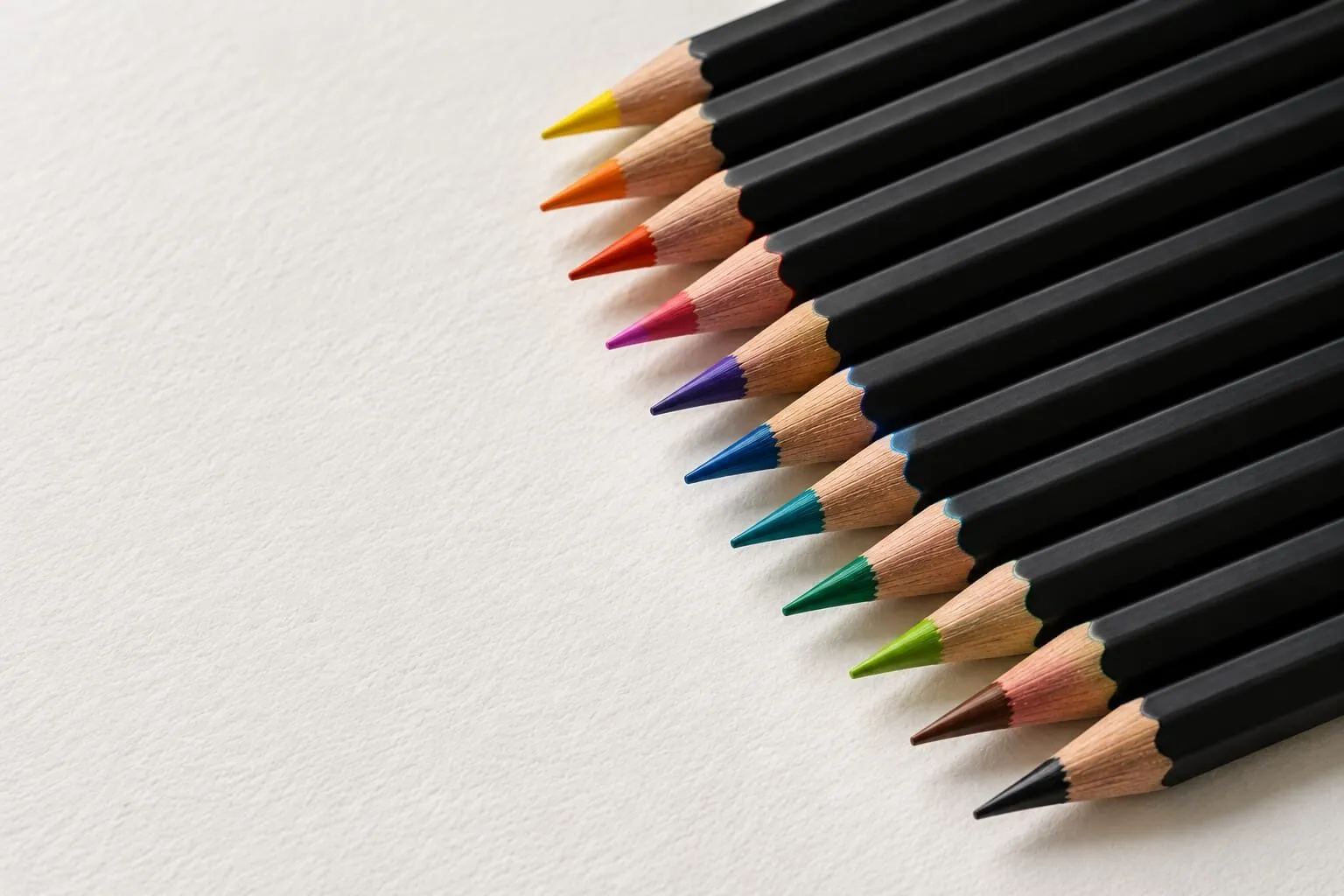
A row of sharpened coloured pencils fanned across white paper.
Why layering means fewer pencils
Coloured pencil pigment is translucent to varying degrees, so a layer of blue over yellow reads as green, and a light layer of red over brown shifts the brown warmer. That is why a small set can produce a wide gamut. Two things control the result: which colours you stack, and how firmly you press.
A single pencil also produces a whole range of tones. Pressed lightly it gives a pale tint, and pressed firmly it gives a saturated, dark version of the same hue. So one mid-blue can serve as sky, shadow and water if you vary pressure and combine it with a few neighbours. The how to layer coloured pencils guide covers the method, and how to match and mix colours with pencils shows how to reach a specific target colour.
Mixing does have limits. Layering can dull a colour, and some very bright or specific hues, such as a clean turquoise or a saturated magenta, are hard to make from muddier parents. That is exactly where owning the pencil is worth it.
Mixing versus owning
A useful rule: own the colours you use constantly and the ones you cannot mix well, and mix everything else.
- Own it if you reach for it in most drawings (a skin-tone brown, a dark for shadows, a white), if it is a clean, bright hue that layering would dull, or if you need it to match a specific subject such as a brand colour.
- Mix it if it is a tint or shade of a colour you already have, if it sits between two pencils you own, or if you only need it once.
Mixing also teaches colour sense. Artists who mix learn how hues interact, which makes their palettes more harmonious. The colour theory guide explains the relationships behind that, and value matters more than exact hue, as value in drawing explains.
Building a core palette
Rather than buying by count, build by role. A practical core looks like this.
- Warm and cool primaries. A warm and a cool red, yellow and blue. Having both lets you mix cleaner secondaries, because mixing a warm red with a cool blue gives a duller purple than a cool red with a cool blue.
- Earth tones. A yellow ochre, a burnt sienna or red-brown, a dark brown and a warm grey. These carry most natural subjects.
- Greens. Two or three, from a yellowish leaf green to a deep, cool green. Greens are the hardest colours to mix convincingly for many artists.
- A dark. A deep indigo, dark brown or black for the deepest shadows. Some artists prefer to build darks by layering; others keep a black to save time.
- Light colours. A cream or pale yellow and a light grey for soft highlights and light backgrounds.
- A good white. Opaque and creamy if possible; it earns its place on toned paper especially. See why use grey paper for coloured pencil for where a white does the most work.
That list is roughly two dozen pencils, which is why 24 to 36 is such a comfortable working size. Building it from open stock, or from a set plus extras, costs the same or less than an oversized tin you only half use.
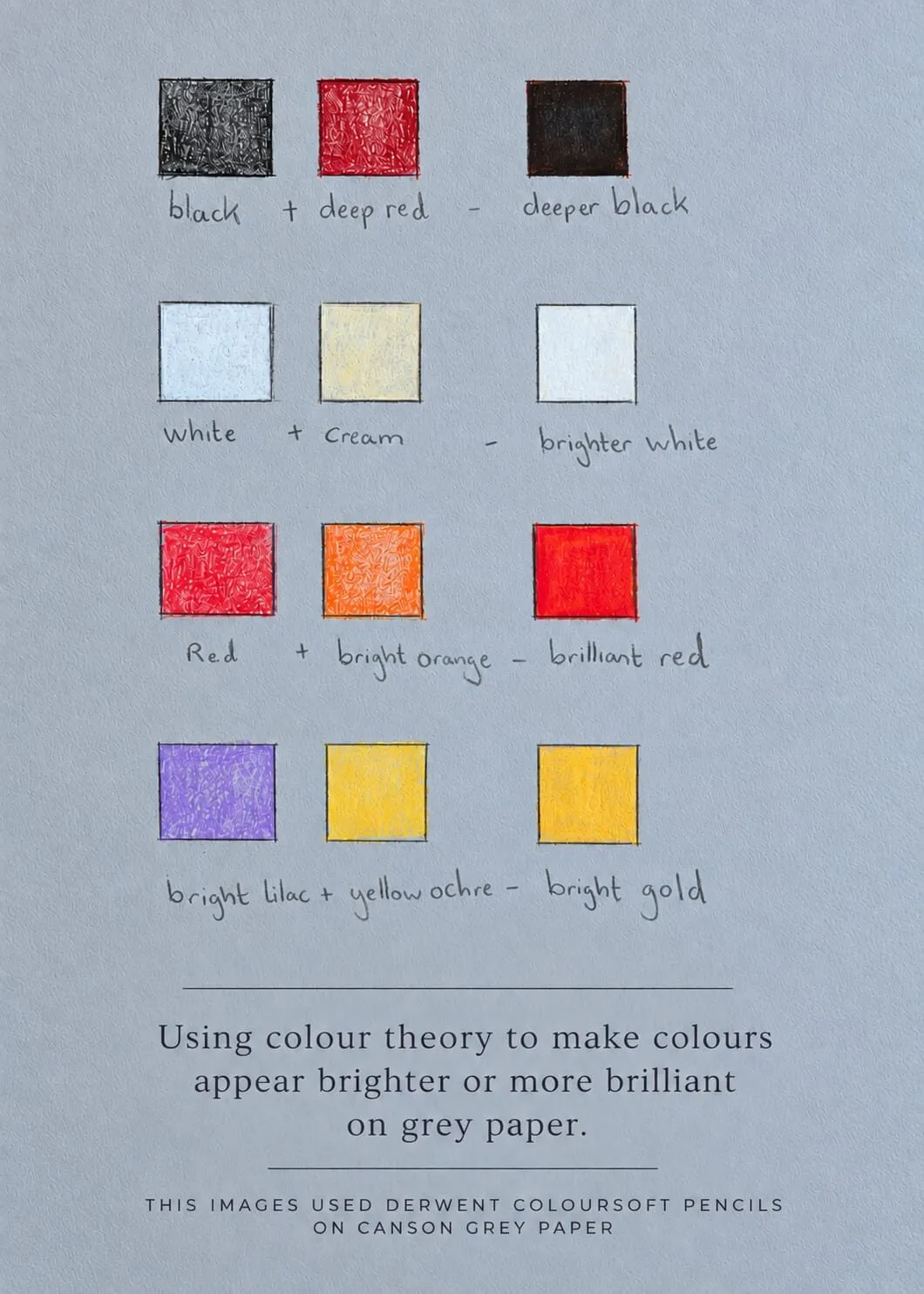
A swatch card of layered pairings on grey paper. Recording which combinations you like is the fastest way to learn what to own and what to mix.
Open stock versus sets
Sets give you a curated range, a case and a lower price per pencil. Open stock lets you replace a worn-out white or add a single hue without buying twenty more.
- Buy a set when you are starting, want a coherent range from one line, or need the convenience of a tin.
- Buy open stock when you know exactly what is missing, or you go through certain colours (whites, browns, darks) faster than others.
- Mix lines with care. Combining wax-based and oil-based pencils works well for many artists, but the layers behave differently. The wax versus oil-based guide explains what to expect.
Not every line is available as open stock in every region, so check what your supplier sells before committing to a range you plan to grow.
Choosing by subject
Different subjects lean on different parts of the palette.
- Portraits. A restrained range of warm browns, reds, ochres, cool shadows and neutrals does most of the work. Skin is mixed, not matched. See how to mix skin tones with coloured pencils.
- Still life and food. A small set of saturated colours plus a white, a cream and a few darks handles glossy glazes and shadows well.
- Landscape and skies. Blues, greens, warm greys and a wide range of pale tints; watch the greens.
- Botanical and wildlife. Many near neighbours in greens, browns and greys help, so larger ranges start to earn their keep here.
- Metal and glass. Neutrals, cool greys, a strong dark and a bright white matter more than a rainbow. The glossy surfaces guide shows why.
The upgrade path
A sensible route is gradual rather than a single jump.
- Start small. A set of 12 to 24 in a forgiving line, plus a white, teaches pressure and layering.
- Fill gaps. After a month or two of drawing, note which colours you run out of and which ones you cannot mix. Buy those as open stock.
- Improve quality, not only quantity. When colours turn muddy, layers stop building or cores snap, a higher-grade line will help more than extra hues. Professional versus student coloured pencils explains the difference.
- Specialise. Once you know your subjects, expand in the areas you use: more greens for landscapes, more earths for portraits.
Set comparisons are in best coloured pencil sets, and the best coloured pencils guide covers the artist-grade lines.
Common mistakes
- Buying the biggest set first. It looks generous, but many pencils will be near-duplicates and quality is often lower per pencil than a smaller premium set.
- Ignoring paper and sharpener. A modest set on good paper with a decent sharpener outperforms a large set used badly. See best paper for coloured pencils.
- Never using the darks. Many beginners underuse their darkest pencils, so drawings look pale. Include one in your core and use it.
- Chasing every hue. Pencil manufacturers offer subtle variations that only matter to specialists. Concentrate on value and temperature first, then on exact hue. A limited palette is a good exercise in what a few pencils can do.
The short version
Start with 12 to 24 good pencils and a white, aim for a working core of roughly 24 to 36 built by role, mix whatever you can, and buy open stock for the colours you use most or cannot mix. Upgrade quality when the pencils, not your technique, are holding the drawing back, and use the which pencil set quiz if you want a shortlist matched to your subject and budget.
Quick answers
Frequently asked questions
How many coloured pencils do I need as a beginner?+
A set of 12 to 24 is plenty to start. You can mix new colours by layering, so a small set of good pencils teaches more than a huge set of weak ones. Add open stock, especially a good white, as your own drawings show what is missing.
Is a set of 120 coloured pencils worth it?+
It is worth it if you draw subjects with many similar hues, such as botanical or wildlife work, and you dislike mixing. For most people it is more convenient than necessary. A well-chosen 36 plus open stock often covers the same ground with less clutter.
Can I mix colours with coloured pencils?+
Yes. Layering one colour over another gives a new colour, and the order and pressure change the result. Mixing is one of the main skills of the medium, which is why you do not need one pencil for every hue you can imagine.
Are colored pencils and coloured pencils the same?+
Yes. Colored is the US spelling and coloured the UK spelling, and both describe the same pencils. Sets are often sold under either spelling, so search both when you shop.