Colour Theory
Primary, Secondary and Tertiary Colours in Coloured Pencil
How primary, secondary and tertiary colours work in coloured pencil (colored pencil in the US), why pencil primaries are never pure, and a good mixing set.
Key takeaways
- ◆Primaries cannot be mixed from other colours, secondaries are mixes of two primaries, and tertiaries sit between the two.
- ◆Pencils mix by optical layering: one colour is laid over another and the eye combines them, unlike paint which is physically stirred.
- ◆No pencil is a pure primary, so mixes come out duller in some areas of the wheel, especially greens and violets.
- ◆A useful limited set needs a warm and cool version of each primary, plus a white, a dark and a couple of earth tones.
- ◆Test every mix on your own paper and write down the layer order so you can repeat it.
Ask what the primary colours are and most people answer red, yellow and blue without hesitation. Ask why a mix of a “blue” pencil and a “yellow” pencil gives a murky green and the answer is less obvious. The definitions are simple. What happens when real pencil pigment meets real paper is where the useful knowledge lives.
This guide gives you the definitions, explains how pencils mix differently from paint, admits why pencil primaries are never pure, and suggests a small set of pencils that will mix a wide range. It follows on from the colour wheel explained and sits within the colour theory hub. This concerns coloured pencils, called colored pencils in the US. For a set that mixes well, take the pencil set quiz and see how many coloured pencils you need.
The definitions in one minute
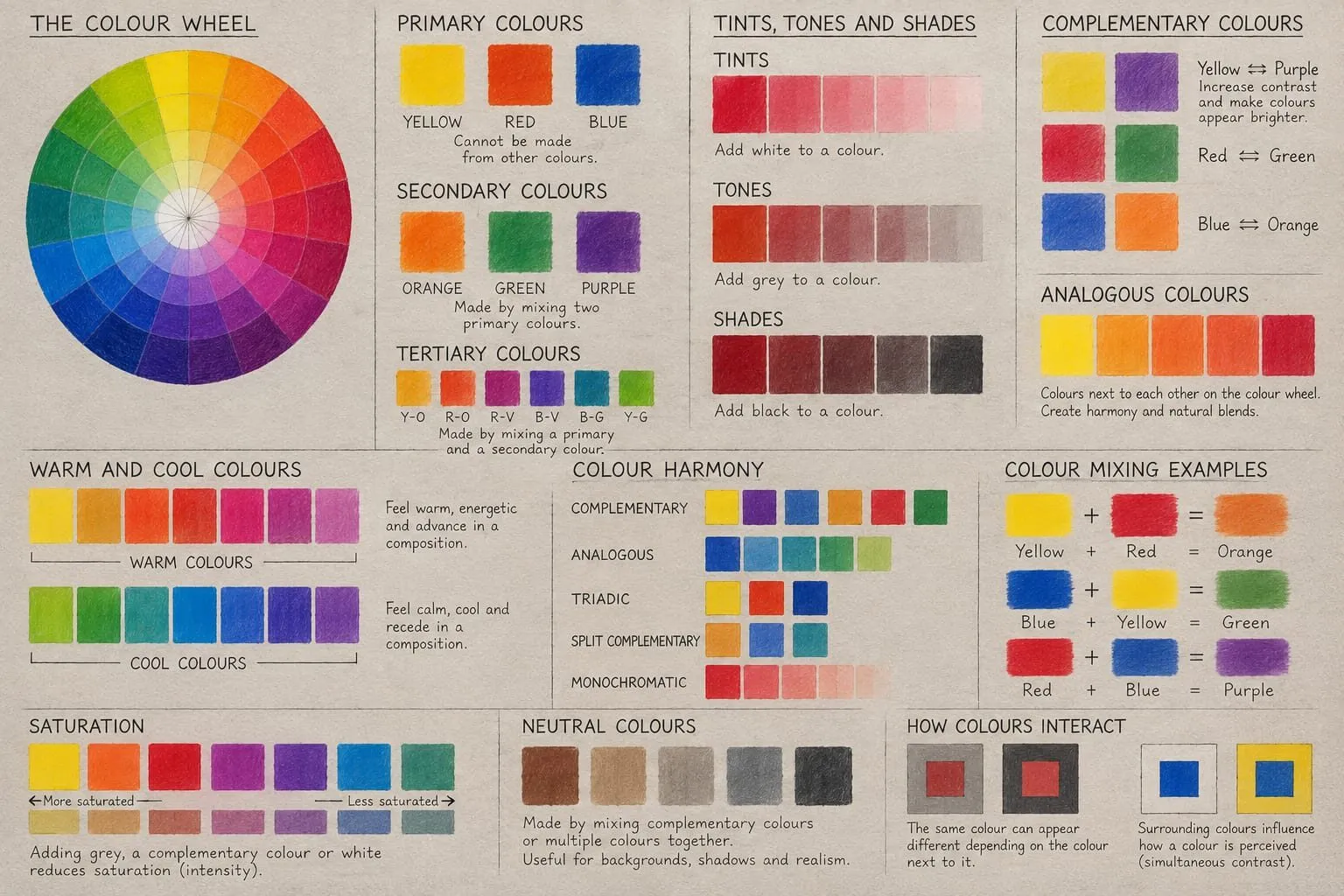
Primary colours are the ones you cannot make by mixing others. On the traditional artist’s wheel they are red, yellow and blue.
Secondary colours are made by mixing two primaries in roughly equal amounts:
- Red and yellow make orange.
- Yellow and blue make green.
- Blue and red make violet.
Tertiary colours are made by mixing a primary with the secondary next to it, or in other words unequal amounts of two primaries: red-orange, yellow-orange, yellow-green, blue-green, blue-violet and red-violet.
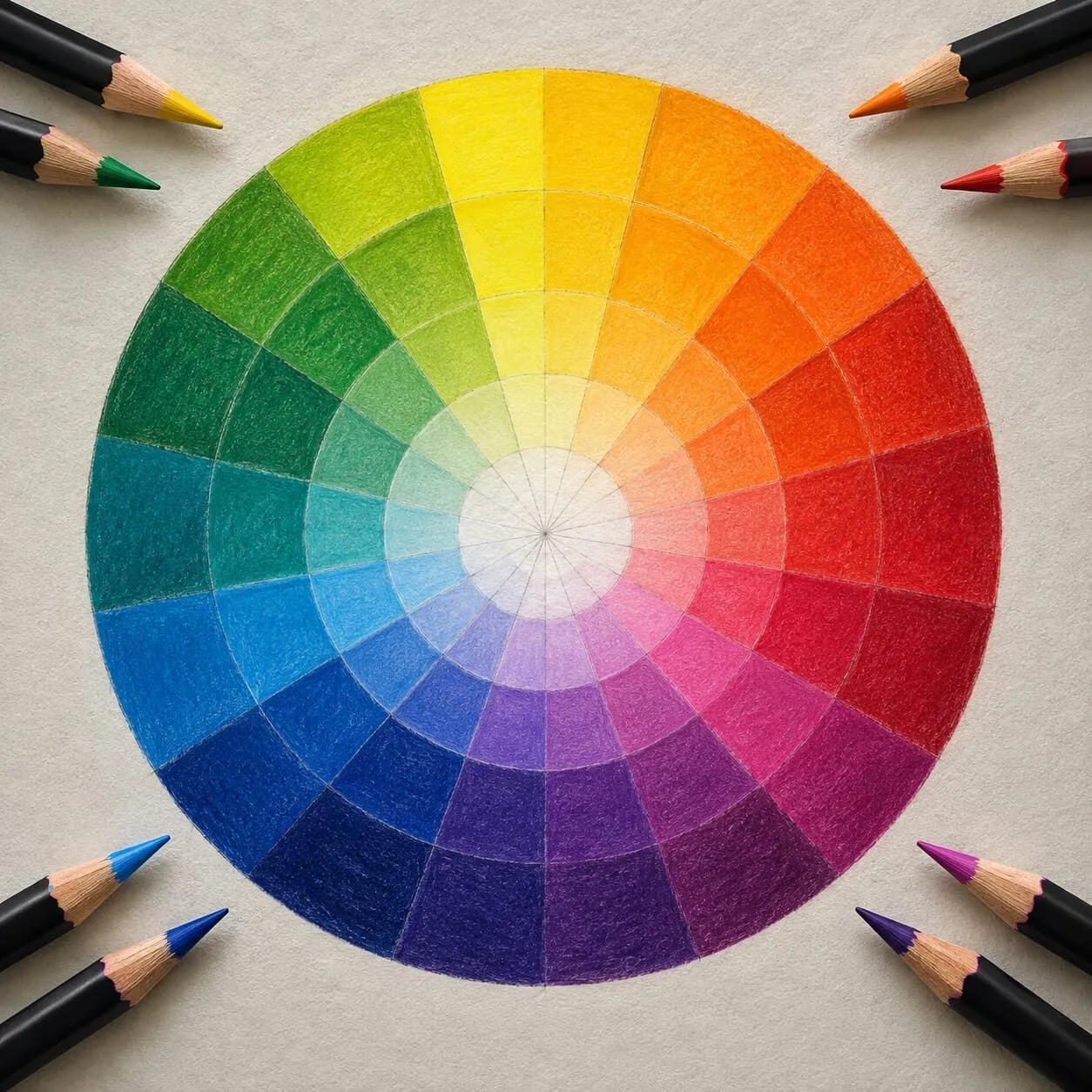
Together these give the twelve-colour wheel. If you are curious about the digital alternative, which uses red, green and blue light, the RYB versus RGB comparison in the wheel guide covers it.
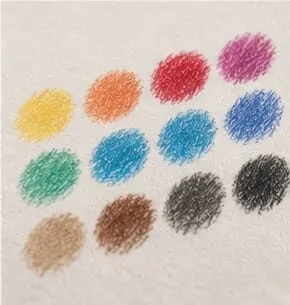
Round swatches of coloured pencil in yellow, orange, red, pink, green, blue, brown and black on cream paper.
How pencils mix, and how it differs from paint
Paint is mixed on a palette. The pigments are stirred together into one new colour before it touches the paper. Coloured pencil has no palette. Mixing happens on the paper, in layers, and there are three ways of doing it.
Optical layering
You lay one colour lightly, then a second over it. The paper’s tooth catches pigment from both, and the eye combines the tiny points of colour. This is the main method, and it is why light, even layers with a sharp point give the cleanest mixes. The technique is covered in how to layer coloured pencils.
Blending
Blending smooths the layers so the marks disappear. You can use pressure, a pale or colourless pencil, or solvent. It merges the colours more thoroughly but can dull them and fill the tooth, so it is worth reading how to blend coloured pencils before you rely on it.
Burnishing
Burnishing is pressing hard with a light pencil to flatten tooth and create a smooth, glossy finish. It locks pigment in and leaves little room to add more colour, so it belongs at the end. See how to burnish coloured pencils.
Order matters in all three. Because you cannot remove pigment easily, the sequence in which you layer changes the result: a yellow layered over blue reads differently from blue over yellow, and the top layer tends to dominate.
Why pencil primaries are never pure
The theory says red, yellow and blue mix everything. In practice, every pigment leans slightly toward a neighbour. A “red” may be leaning toward orange or toward violet. A “blue” may be leaning toward green or toward violet. Mix two colours that lean in opposite directions and the result is muddy, because you have quietly added a small amount of the third primary, which neutralises the mix.
Take green. If your blue leans toward violet and your yellow leans toward orange, each carries a trace of red, and the mix is a dull olive rather than a fresh green. Use a blue that leans toward green and a yellow that leans toward green and the mix stays clean. This is the practical meaning of warm and cool versions of each primary, covered further in colour temperature: warm and cool.
The honest conclusion is that a three-pencil set will not mix everything. That is not a failure of the theory, it is what an impure-pigment version of the wheel looks like, and it is exactly what a hand-made wheel shows.
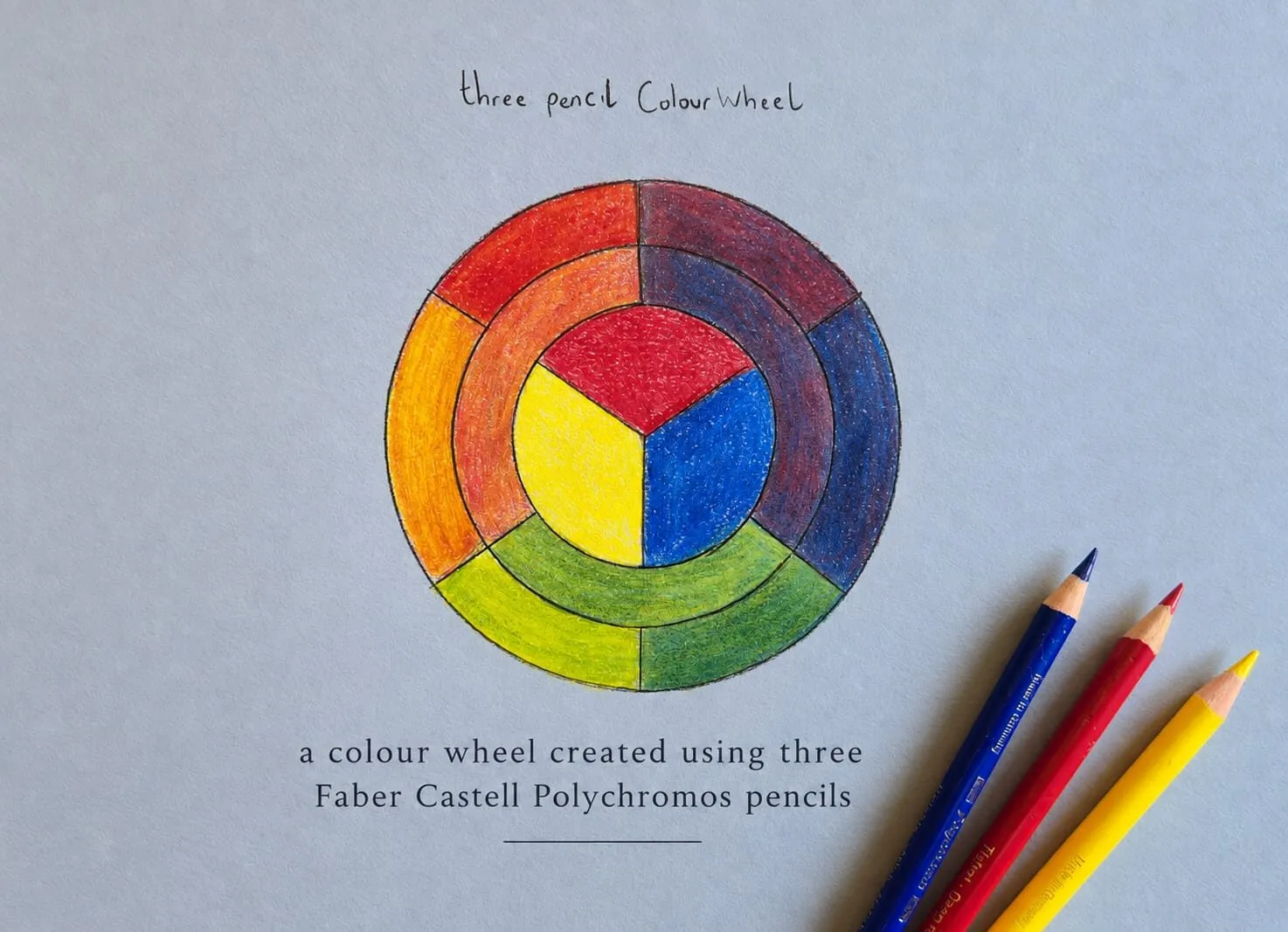
Michael’s three-pencil wheel makes the limits of a small set easy to see. Where the mixes weaken, a fourth pencil helps.
Which pencils to buy for a limited mixing set
If you want to mix rather than choose from a tin of seventy-two, here is a set we would start with. It is described by colour role, not by brand, so it works with any range.
| Role | Why you need it |
|---|---|
| A warm red (leans orange) | Makes clean oranges and warm skin tones |
| A cool red (leans violet or pink) | Makes clean violets and rosy mixes |
| A warm yellow (leans orange) | Makes rich oranges and golden light |
| A cool yellow (leans green) | Makes clean greens and lemon tones |
| A warm blue (leans violet) | Makes violets and deep shadows |
| A cool blue (leans green) | Makes clean blue-greens and teal |
| A white | Lightens and works as a blending pencil |
| A dark (indigo, dark brown or black) | Deepest shadows and neutrals |
| A warm grey or earth tone | Mutes colours and makes skin and landscape mixes |
That is nine or ten pencils. To make the most of them, the limited palette drawing guide shows how to pick and mix from a small set in a real drawing. If you are still choosing pencils, best coloured pencils for beginners compares ranges, and how to match and mix colours with pencils shows the technique.
Exercise: build a mixing chart
This takes about thirty minutes and pays back for years.
- Choose six pencils from the table: warm and cool versions of each primary.
- Draw a grid of squares six across and six down, with your six pencils labelled along the top and side.
- Fill each square by layering the column pencil and the row pencil, using light even strokes. Put the column pencil down first.
- Repeat with reversed order in a second grid if you want to see how layer order changes the result.
- Mark your winners. Circle the clean mixes and cross the muddy ones.
- Add white over some squares to see how tints behave.
You now have a personalised map of what your pencils can do. Keep it, on the paper you use, beside your desk.
Common mistakes
- Mixing opposites accidentally. A red-leaning blue with an orange-leaning yellow gives mud. Choose pencils that lean toward each other.
- Pressing hard too early. Heavy first layers fill the tooth and block later colours.
- Trusting the barrel colour. The painted end of a pencil is often not the colour it draws. Swatch every pencil.
- Forgetting value. A mix that is the right hue but the wrong lightness will still look wrong. Check with the value study tool.
Tints, tones and shades
Once you can mix hues, three words describe how to change them, and they are worth knowing because they map directly onto pencil technique.
- Tint: a colour lightened. In pencil, that means lighter pressure, fewer layers, or a white or pale layer over the top.
- Shade: a colour darkened. Add a dark of the same temperature, or a deeper related colour, rather than jumping straight to black.
- Tone: a colour muted with grey or its complement, which lowers saturation without changing value much.
Every mix you make can be adjusted along these three directions. If a green is too bright, tone it with a little red. If it is too dark, tint it. If it needs more depth, shade it with a deep blue. Thinking in these terms makes it much easier to correct a mix by name instead of guessing.
The short version
Primaries are the colours you cannot mix, secondaries and tertiaries are the mixes between them, and pencils mix by layering on the paper. Because no pencil primary is pure, buy warm and cool versions, add a ready-made green and violet, and test every mix on your own paper. When you are ready to plan whole palettes, continue to colour harmony schemes.
Quick answers
Frequently asked questions
How do you mix colours with coloured pencils?+
You layer them. Lay down one colour lightly, then layer a second over it, and the eye combines the two. Alternate light layers for smoother mixes, and blend with a pale pencil or a blender if you want the marks to disappear. Pressing hard early makes later layers harder to add.
Why do my mixed greens and purples look dull?+
Because pencil primaries are impure. A blue that leans slightly toward red and a yellow that leans slightly toward orange each carry a hint of a third colour, and mixing them produces a duller green. Choose primaries that lean toward each other, and add a ready-made green or violet to the set.
What is the difference between layering and blending in coloured pencil?+
Layering is putting different colours over each other so they combine visually. Blending is smoothing the layers together so the individual strokes vanish, using pressure, a light pencil or a solvent. You can layer without blending, and often should.
Which coloured pencils should I buy for colour mixing?+
Buy a warm and a cool version of red, yellow and blue, plus a white, a dark such as indigo or dark brown, and a neutral like a warm grey. That is about ten pencils and mixes a very wide range.
Are colored pencils and coloured pencils the same?+
Yes. Coloured pencils is the UK spelling and colored pencils is the US spelling, and they are the same product. The mixing advice applies to both.