Coloured Pencils
Best Pencil Sharpeners for Coloured Pencils
Soft coloured pencils (colored pencils in the US) snap in the wrong sharpener. Here are the best options for long, clean points, plus technique and maintenance.
This guide contains affiliate links. If you buy through them we may earn a small commission at no cost to you. How this works.
Jump to recommended products
Key takeaways
- ◆If your pencils keep snapping or wasting pigment, the sharpener is often the culprit rather than the pencil.
- ◆Sharp, precise blades cut cleanly without crushing soft cores, which is the main thing to look for.
- ◆Derwent Super Point, M&R brass sharpeners and the KUM Automatic Long Point are the three options we would start with.
- ◆Turn the pencil slowly and use light pressure, and replace or clean a dull blade before it damages a good pencil.
- ◆A sandpaper block is a useful finishing tool for a fine point but should not be your main sharpener.
Coloured pencils (colored pencils in the US) are soft, and soft things break. If you have ever sharpened a lovely, expensive pencil only to watch the core fall out in pieces, you know the frustration. The instinct is to blame the pencil. In practice it is very often the sharpener.
This guide explains why cores snap, what to look for in a sharpener, and the three we would start with. It also covers technique and maintenance, because a good tool used badly still ruins pencils. For a step-by-step method see how to sharpen coloured pencils, and for softening and smoothing once you have a point, best blending tools for coloured pencil.
Why coloured pencil cores snap
Coloured pencil cores are made from pigment and binder, and many are soft wax. That is what gives you rich, creamy colour, but it means they have far less structural strength than a graphite or a hard writing pencil.
Several things put stress on a core:
- A dull blade. It tears and crushes the wood instead of slicing it, sending shock into the core.
- Too steep an angle. A stubby, blunt cut leaves a wide wedge of core that breaks under pressure.
- Rough handling. Dropped pencils often develop internal breaks, so a pencil that keeps snapping even in a good sharpener may already be cracked.
- Rushing. Twisting hard and fast heats and stresses the core.
Because a soft pencil is expensive and every snapped tip wastes pigment, a good sharpener pays for itself. Michael’s advice in his guides is blunt: if your pencils keep snapping, it is often the sharpener, not the pencil.
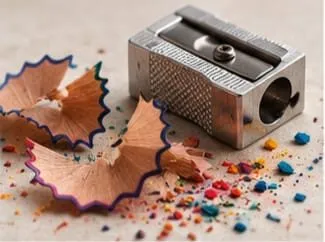
A metal pencil sharpener with coloured pencil shavings.
What to look for
Blade quality. A sharp, fine blade that cuts cleanly matters more than anything else. Replaceable blades are a big advantage because you can renew the edge when it dulls.
Point length. A long, tapered point is ideal for detail such as eyes, hair and fine textures, because it lets you draw with the very tip. A shorter point is stronger and better for broader coverage.
Gentle fit. The pencil should sit firmly without wobbling or being crushed.
Waste collection. Wood shavings and pigment dust are messy. A sharpener that traps them keeps your workspace and your paper clean.
Blade type: what actually matters
You will meet a few designs, and each behaves differently.
| Type | Strengths | Watch out for |
|---|---|---|
| Fine metal hand sharpener, single blade | Precise, gentle on cores, blade can often be replaced | Slower, takes practice |
| Long-point hand sharpener | Long tapered points for detail | Fragile points if you press hard |
| Automatic or electric long point | Fast, consistent, minimal effort | Can break soft cores if blades are dull or poor |
| Craft knife or blade | Full control, ideal for shaping | Slow, needs skill, cuts more wood away |
Two black spiral-bound sketchbooks stacked together.
The best coloured pencil sharpeners
Derwent Super Point
The Derwent Super Point creates long, tapered points that suit detail work, especially around eyes, hair and fine textures. It is a natural pairing if you already use Derwent pencils, and a sensible first purchase for artists who want a dedicated tool for delicate points. See our Derwent coloured pencils reviewed for the pencils that suit it best.
M&R brass sharpeners
M&R brass sharpeners are small, precise and durable, and gentle on cores. Michael describes them as incredibly reliable, and many professional artists swear by them. They are simple, so there is nothing to break, and a sharp blade cuts cleanly rather than crushing the core. If you want one dependable hand sharpener that will last for years, this is where we would start.
KUM Automatic Long Point
The KUM Automatic Long Point produces razor-sharp points with minimal breakage, which makes it perfect for artists who need precision. It is a good choice if you sharpen frequently or draw with a very fine point, and it is quicker than a hand sharpener. Like all mechanical sharpeners, it needs a sharp blade to be kind to soft cores.
Hand or electric?
Hand sharpeners give you control. You feel the resistance, can stop the moment the point is right, and rarely oversharpen. They cost little, are quiet, and work anywhere.
Electric sharpeners are quick and produce even points, which helps if you work through many pencils. The downside is less feedback, and cheaper models can crush soft cores. If you go electric, choose a long-point automatic model and stop as soon as the point forms.
For most artists working in soft wax pencils, a good hand sharpener is the safer choice, with an automatic one as an optional extra.
Sharpening technique
Even a good sharpener fails with poor technique.
- Hold the pencil steady and turn slowly. In a hand sharpener, rotate the pencil rather than the sharpener when you can, with light, even pressure.
- Stop as soon as the point forms. Continuing to sharpen wears the core away for no benefit.
- Tap out loose crumbs before drawing, so you do not scratch the paper.
- Sharpen away from your work, and never over a drawing.
- Do not force a snapped tip. If a pencil breaks repeatedly, retire it or check it for internal cracks.
Sandpaper pointing
A small sandpaper block is a useful finishing tool. After sharpening, a few light strokes at a low angle refine the tip to a fine, controlled point, and let you re-point as you draw without a full sharpen. Use it for shaping only, not as your primary tool, and keep the dust off your paper.
Maintenance
- Replace dull blades. If a sharpener starts to tear the wood or leave a ragged edge, change the blade or replace the tool.
- Clean the shavings. Wax and pigment build up and clog the mechanism.
- Store pencils properly. Keep them in a case or tin so the tips do not knock together and crack.
- Avoid drops. Internal breaks can only be cured by removing the damaged length.
Sharpening for different pencils
Softer pencils need extra care. Firm oil-based pencils such as Polychromos hold a longer point and tolerate a longer taper; soft wax pencils prefer a slightly shorter, sturdier point. See the Polychromos review and the Luminance review for how each behaves, and wax versus oil-based pencils for the underlying difference.
Troubleshooting common problems
The point breaks the moment you draw. The core may be cracked inside the wood, or the point is too long and thin for the pressure you use. Shorten the taper, lighten your touch, and if it persists, sharpen back past the break.
The wood tears or splinters. The blade is dull. Replace it or change the sharpener.
The point is off-centre. The core may be poorly bonded in the pencil, or the sharpener is not gripping evenly. Try a different sharpener before blaming the pencil.
Wax smears in the sharpener. Soft wax builds up on blades and clogs the mechanism. Clean the blade with a cloth and tap out the shavings regularly.
Points dull too fast. Soft pencils simply do this. Rotate the pencil as you draw and refresh the tip with a sandpaper block rather than a full sharpen.
Sharpening, workflow and saving pencils
A small routine saves time and pencils. Before a session, sharpen the pencils you expect to use for detail and lay them out in a tray or case. Keep the dull ones for broader tone. When a pencil gets short, use a pencil extender rather than fighting with a stub, because a tiny pencil is harder to sharpen safely and to hold at a low angle.
Storage matters as well. Keep pencils in a tin, roll or case with the tips protected, because soft cores crack when they knock against each other in a drawer. Avoid leaving them in a hot car or on a sunny windowsill, where softer wax pencils can warp.
Which sharpener for which artist
| If you… | Consider |
|---|---|
| Want one reliable, low-cost tool | An M&R brass sharpener |
| Draw fine detail and want long points | A Derwent Super Point |
| Sharpen many pencils quickly and want precision | A KUM Automatic Long Point |
| Need occasional ultra-fine tips | Any of the above plus a sandpaper block |
Match the tool to the pencils in your case too. See best coloured pencils for which pencils are firm and which are soft, because firmer pencils tolerate more aggressive points.
The short version
If your pencils keep snapping, upgrade the sharpener before you blame the pencil. Start with an M&R brass sharpener for reliability, add a Derwent Super Point or a KUM Automatic Long Point for long detail points, sharpen slowly, and replace dull blades. Good points make detail easier and waste less pigment, and once you have them, the rest of our coloured pencil guides will make more sense.
Where to buy
Recommended products
Affiliate links. We may earn a small commission if you buy, at no extra cost to you. Why?
Tool · Derwent
Derwent Pencil Sharpener
A dependable sharpener for keeping soft cores intact.
Buy on AmazonAffiliate link · opens Amazon
Quick answers
Frequently asked questions
Why do my coloured pencils keep breaking when I sharpen them?+
The core is usually cracked or crushed by a dull blade, too much pressure, or a sharpener that cuts a very steep angle. Soft wax cores are the most fragile. Switch to a sharp blade, sharpen slowly with light pressure, and avoid pencils that have been dropped, because internal breaks appear as repeated snapping.
What is the best sharpener for soft coloured pencils?+
A sharp, precise sharpener with a single fine blade, such as a good metal hand sharpener, treats soft cores gently. Long-point designs suit detail work. Whichever you choose, replace the blade when it starts to tear the wood rather than cut it.
Are electric sharpeners good for coloured pencils?+
They can be quick and produce consistent points, but many crush or break soft cores if the blades are dull or the fit is rough. A good long-point automatic model can work well. If you use one, feed pencils gently and stop as soon as the point is formed.
How do I keep a fine point while drawing?+
Rotate the pencil as you draw so the point wears evenly, and use light pressure. Refine a dulled point with a few strokes on a sandpaper block or resharpen when needed. Keeping a small stack of sharp pencils ready avoids stopping mid-detail.
Are colored pencils and coloured pencils the same?+
Yes. Coloured pencils is the British spelling and colored pencils is the American one, and both describe the same drawing medium: pigment in a wax or oil binder, set in a wooden barrel. Brands, sets and techniques do not change with the spelling, so advice about one applies equally to the other. Only shop listings and product names follow one spelling or the other.